
திருவாசகத்தில் ஐம்புலனடக்கம்: சைவ சித்தாந்த மெய்யியல், அறிவியல் மற்றும் சமூக-உளவியல் பார்வைகளின் ஓர் ஆய்வு
Control of the Five Senses in Thiruvasagam: An Analytical Study of Saiva Siddhantha Philosophy, Science, and Socio-Psychological Perspectives
DOI:
https://doi.org/10.63300/tmv11spi022026.02Keywords:
Five Senses, Manickavasagar, Thiruvasagam, Saiva Siddhantha, Sensory Control (Pulanadakkam), Liberation (Veeduperu)Abstract
Thiruvasagam, which stands as the eighth volume of the twelve Thirumurais, is a supreme philosophical treasure that explains the evolutionary growth of the human soul and the methods to remove the malas (impurities) that hinder it from reaching the Divine. Specifically, Manickavasagar elaborates extensively through various metaphors and similes on the dominance of the five senses and the necessity of disciplining them.
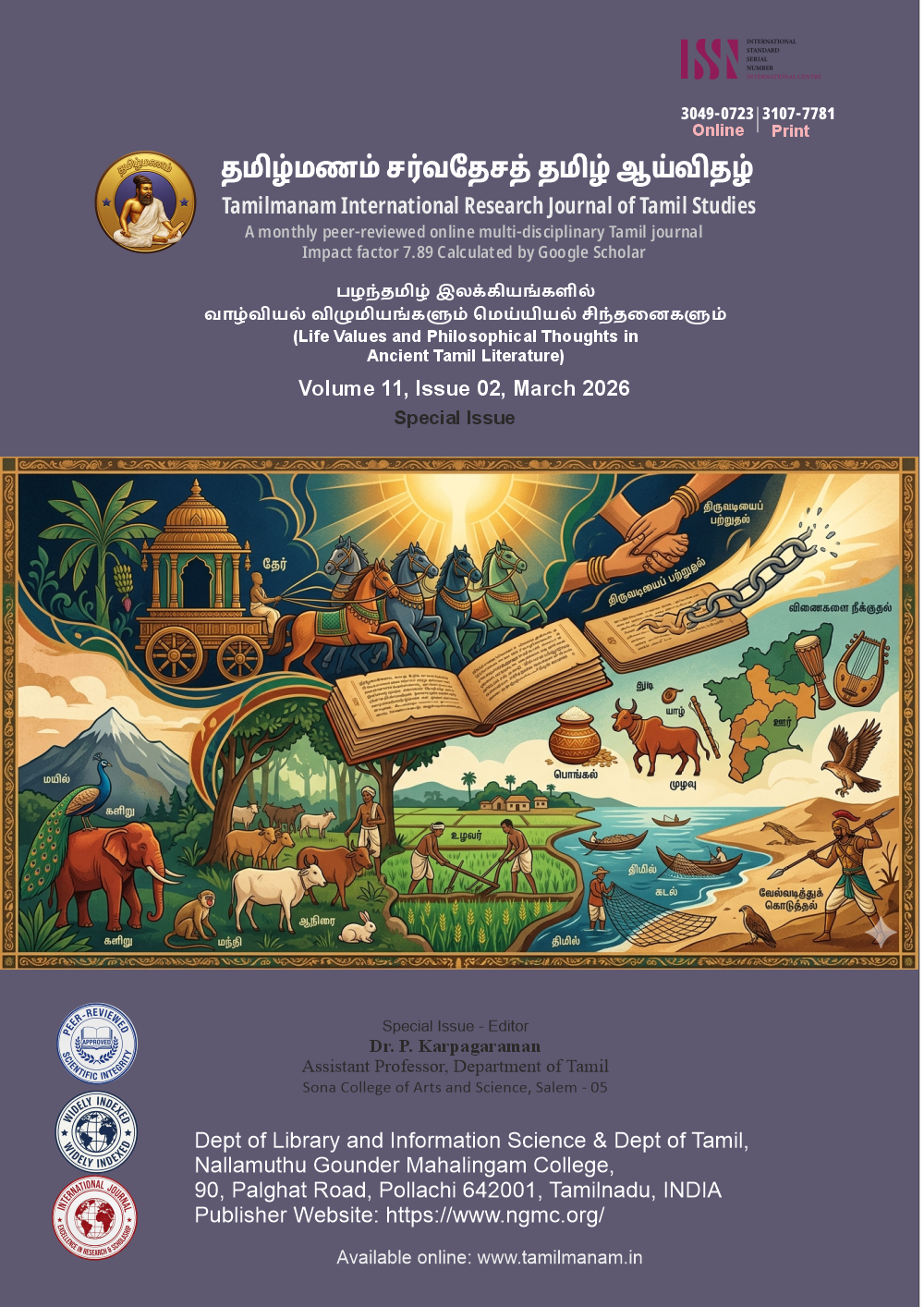
The human body is likened to a chariot, while the five senses are viewed as the horses pulling it. Only if these horses operate under proper guidance can the soul reach the goal of Veeduperu (Liberation/Salvation). Conversely, the central theme of Thiruvasagam posits that if each sense pulls in a different direction, the soul will suffer, submerged in the great ocean of births.
Based on the hymns regarding the control of the five senses in Thiruvasagam, this research paper provides a detailed analysis of the methods suggested by Manickavasagar to control the senses and the miseries resulting from sensory indulgence, framed within the contexts of Saiva Siddhantha, modern science, and psychology. Furthermore, this article demonstrates how sensory control aids not only in spiritual maturity but also in living as a complete human being.
Downloads
References
1. Varatharajan, G. Thiruvasakam Virivurai. Palaniappa Brothers, 2023. 1
2. Kathir Murugu, Dr. Thiruvasakam Moolamum Uraiyum. Saradha Pathippagam, 2009. 1
3. Bhuvaneswari, K., and K. Vijayalakshmi. "Thiruvasagam's Literary Principles." International Research Journal of Tamil, vol. 4, no. S-13, Nov. 2022, pp. 361-367. DOI: 10.34256/irjt224s1352. 2
4. Subbulakshmi, S. "Thiruvāsagam – A Text of Multi-Discipline." Shanlax International Journal of Arts, Science and Humanities, vol. 8, no. 2, 2022, pp. 50-55. 13
5. Pope, G. U. The Tiruvaacagam or 'Sacred Utterances' of the Tamil Poet, Saint and Sage Maanikka vaacagar. Clarendon Press, 1900. 17
6. "Sattinipada and Divine Grace in Saiva Siddhanta." International Journal for Multidisciplinary Research (IJFMR), vol. 7, no. 5, 2025. 5
7. "Neethal Vinnappam: Commentary and Text." Tamil Virtual Academy, 2017. 11
8. Easwaran, Eknath. "The Chariot Allegory: Katha Upanishad." Thought for the Day, BMCM. 8
Downloads
Published
Issue
Section
License
Copyright (c) 2026 Dr. A. Nasrin (Author)

This work is licensed under a Creative Commons Attribution 4.0 International License.
Our journal adopts CC BY License Creative Commons Attribution 4.0 International License http://Creativecommons.org//license/by/4.0/ . It allows using, reusing, distributing and reproducing of the original work with proper citation.
