
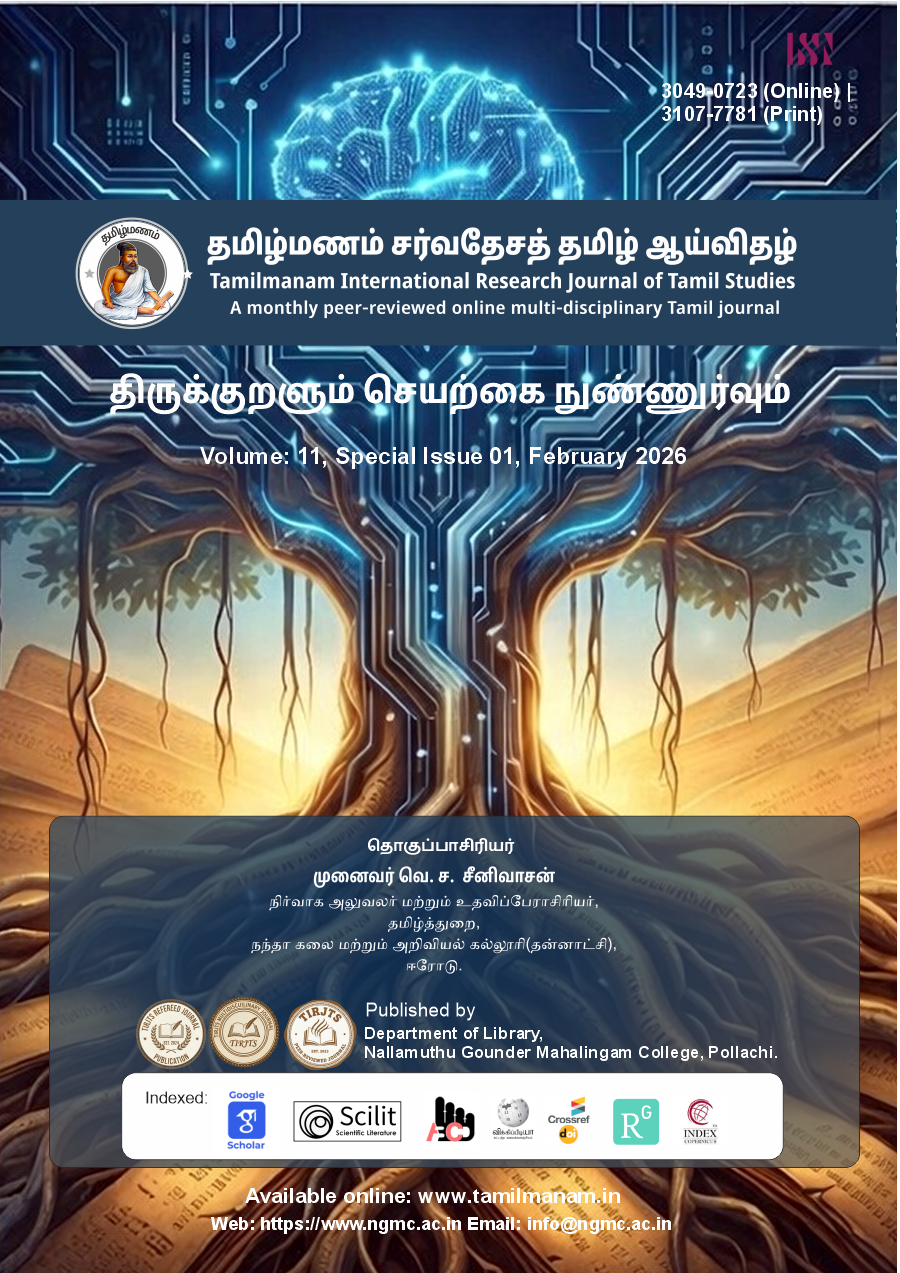
திருக்குறளில் கூறப்படும் தலைமைக் குணங்கள் (Leadership) மற்றும் AI தலைமுறை மேலாண்மை மாதிரிகள் – ஓர் ஆய்வு
Leadership Qualities in Thirukkural and AI-Generation Management Models: A Study
DOI:
https://doi.org/10.63300/tm10sp012026.02Keywords:
Thirukkural, Leadership Qualities, AI Leadership, Ethical AI, Human-Centric Management, Ethics (Aram)Abstract
Management models driven by Artificial Intelligence (AI) have taken center stage in today’s technological world. AI plays a leading role in various domains, such as data-driven decision-making, employee performance evaluation, and organizational resource management. In this context, the ancient Tamil ethical treatise, Thirukkural, serves as an opportunity to provide a humanitarian foundation to these technology-oriented management models.
This research paper analyzes the leadership traits defined by Valluvar in Thirukkural and compares them with modern AI-generation management models. Focusing on six fundamental leadership qualities emphasized in Thirukkural—Virtue (Aram), Integrity, Wisdom, Compassion, Justice, and Accountability—this article explores how these can be integrated as humanitarian attributes within AI systems.
Since AI models rely solely on objective data, there is a risk that humanitarian traits may be neglected. The leadership qualities proposed by Thirukkural provide guidelines for operating AI systems with a more Human-Centric Approach. The central thesis of this study is that this ancient wisdom will help create balanced and ethical AI leadership models by integrating ethics and emotional intelligence alongside data.
This study acts as a bridge between traditional knowledge and modern technology, highlighting the potential for future AI leadership models to emerge as more humane and ethically grounded.
Downloads
References
1. Skeja, A., & Sadiku-Dushi, N. (2025). Toward sustainable AI leadership: ethical blind spots, accountability gaps and the CARE governance framework. Leadership & Organization Development Journal.
2. ScienceDirect. (2024). Generative AI and the future of innovation management: A human centered perspective. Journal of Innovation Management.
3. Brookings Institution. (2025). Hype and harm: Why we must ask harder questions about AI and its alignment with human values. Brookings Research.
4. Bannor, F. O., & Baysah, J. O. (2025). Ethical Leadership Challenges in the Age of Artificial Intelligence: An In-depth Analysis. Pan-African Journal of Education and Social Sciences, 6(2).
5. Ruster, L. P., Oliva-Altamirano, P., & Daniell, K. A. (2025). The Dignity Lens: Advancing Human-Centred Protective and Proactive Algorithmic Responsibility. Wiley Online Library.
6. Xie, Y., et al. (2025). Beyond Procedural Compliance: Human Oversight as a Dimension of Well-being Efficacy in AI Governance. arXiv .
7. Kanwar, J. S., et al. (2025). A Scalable Machine Learning Framework for Predictive Analytics and Employee Performance Enhancement. International Journal of Advanced Computer Science & Applications .
8. Mihalcea, R., et al. (2025). Which Humans? Inclusivity and Representation in Human-Centered AI. arXiv .
9. ScienceDirect (2025). Less human, less positive? How AI involvement in leadership shapes employees' affective well-being. The Leadership Quarterly .
10. EONSR (2025). Paul Atreides AI Forecaster: Predictive Leadership in 2025 .
11. Bannor, F. O., & Baysah, J. O. (2025). Ethical Leadership Challenges in the Age of Artificial Intelligence. Pan-African Journal of Education and Social Sciences, 6(2) .
12. Joshi, S. (2025). Leadership in the age of AI: Review of quantitative models. World Journal of Advanced Research and Reviews, 26(1), 2773-2791 .
13. ScienceDirect (2025). Less human, less positive? How AI involvement in leadership shapes employees' affective well-being. The Leadership Quarterly .
14. Joshi, S. (2025). Leadership in the age of AI: Review of quantitative models. World Journal of Advanced Research and Reviews, 26(1), 2773-2791 .
15. Ruster, L. P., Oliva-Altamirano, P., & Daniell, K. A. (2025). The Dignity Lens: Advancing Human-Centred Protective and Proactive Algorithmic Responsibility. Wiley Online Library .
16. SkillAIbility Project. (2025). Dawn of the Human-Only Era: Reframing Human-Centric AI and Workforce Values. IFAC MIM 2025 Conference Report, NTNU & Politecnico di Milano .
17. Bieńkowska, A., et al. (2025). Person–AI Bidirectional Fit – A Proof-of-Concept Case Study of Augmented Human–AI Symbiosis. arXiv preprint arXiv:2511.13670 .
18. Brookings Institution. (2025). Hype and harm: Why we must ask harder questions about AI and its alignment with human values.
Downloads
Published
Issue
Section
License
Copyright (c) 2026 Dr M. Karthik, Dr. V.C.Srinivasan (Author)

This work is licensed under a Creative Commons Attribution 4.0 International License.
Our journal adopts CC BY License Creative Commons Attribution 4.0 International License http://Creativecommons.org//license/by/4.0/ . It allows using, reusing, distributing and reproducing of the original work with proper citation.
