
இந்து தத்துவத்தில் பாதாள லோகம்: ஆன்மிகமும் பிரபஞ்சமும்
Patala-loka in Hindu Philosophy: Spirituality and the Universe
DOI:
https://doi.org/10.63300/tm10sp032026.14Keywords:
Patala-loka, Hindu Philosophy, Cosmology, Nagas, Puranas, SpiritualityAbstract
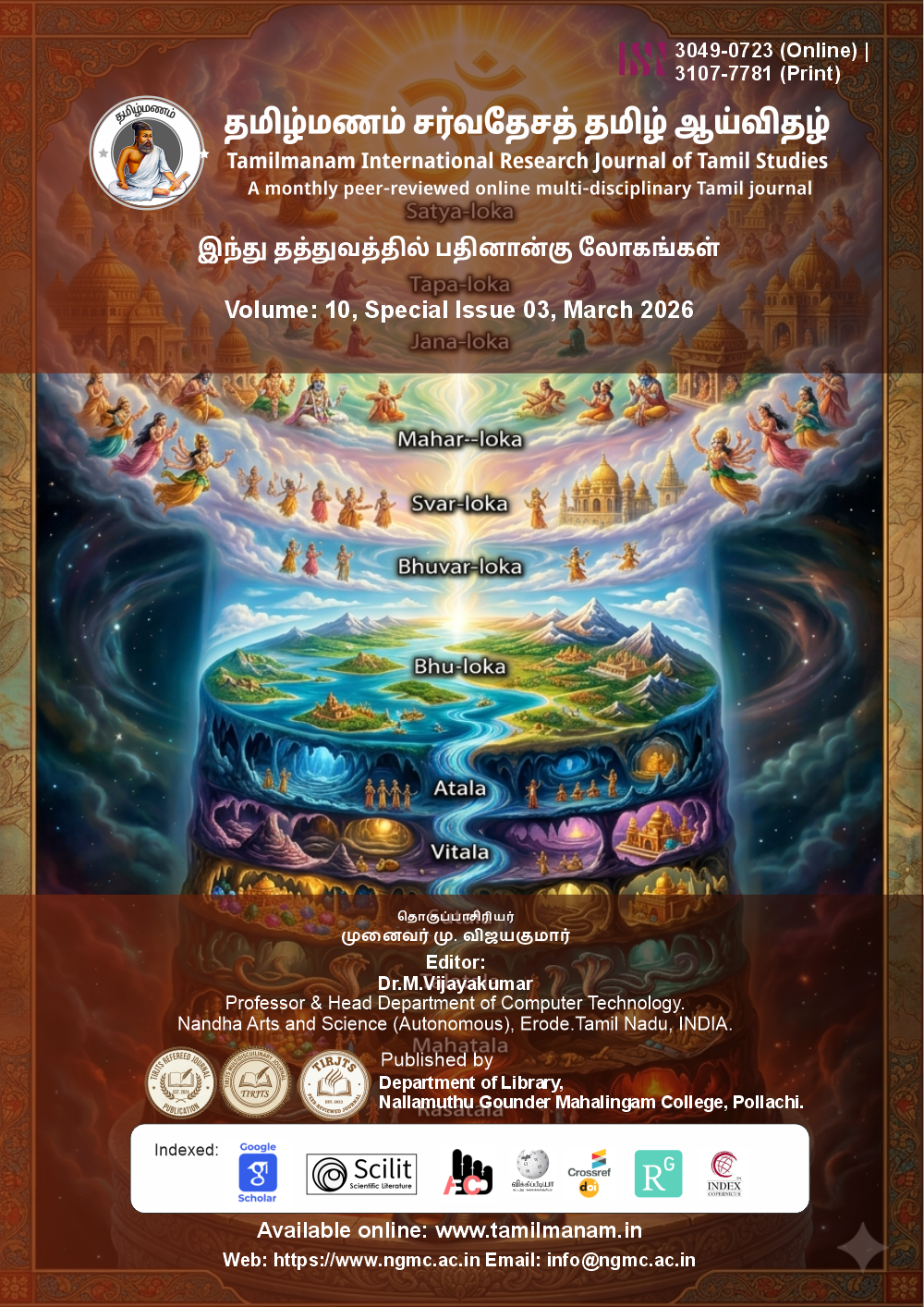
Hindu philosophy explains the structure of the universe with immense depth and breadth. According to the Vedas, Agamas, and Puranas, the cosmos consists of fourteen worlds (Lokas), divided into seven upper worlds and seven lower worlds. Among these, Patala-loka stands as the seventh and most significant of the lower realms. While Patala is commonly perceived only as a world of darkness and suffering, Hindu philosophy describes it as a realm of power, wealth, Naga-kings, and hidden spiritual forces. Puranas such as the Vishnu Purana and Srimad Bhagavatam explain Patala-loka in great detail as a world of Maya (illusion), mantra-shaktis, and supernatural phenomena.
The Puranas state that Naga-kings, including Vasuki, reside here and that this realm is filled with immense opulence. However, Patala is not permanent; its inhabitants must also return to the cycle of rebirth after experiencing the fruits of their karma. The principle that Moksha (liberation) is the only permanent freedom applies here as well. This research article explores the position of Patala-loka in Hindu philosophy, its cosmological structure, mythological descriptions, and spiritual significance. Furthermore, the connection between Patala-loka and human psychology and spiritual growth is explained. Patala is not merely a mythological fantasy; it serves as a metaphor for the deepest layers of the human subconscious. In the journey from darkness to light, Patala is considered one of the stages that a human must transcend.
Downloads
References
1. விஷ்ணு புராணம்
2. பாகவத புராணம்
3. கருட புராணம்
4. மகாபாரதம்
5. Bhagavata Purana. (n.d.). Canto 5, Chapter 24. (Various Translations).
6. Vishnu Purana. (1840). (H. H. Wilson, Trans.). https://sacred-texts.com/hin/vp/
7. Nagaraja. (2025). In Wikipedia. https://en.wikipedia.org/wiki/Nagaraja
8. Shesha. (2025). In Wikipedia. https://en.wikipedia.org/wiki/Adisesha
9. சுவாமி விவேகானந்தர் – இந்து தத்துவம் பற்றிய சொற்பொழிவுகள்
10. Srimad-Bhagavatam. (n.d.). Canto 5, Chapter 25, Verse 1. Bhaktivedanta VedaBase.
11. Vishnu Purana. (1840). (H. H. Wilson, Trans.). https://sacred-texts.com/hin/vp/
12. Māṇi, V. (1975). Purāṇic encyclopaedia: A comprehensive dictionary with special reference to the epic and Purāṇic literature. Motilal Banarsidass.
13. Shesha. (2025). In Wikipedia. https://en.wikipedia.org/wiki/Adisesha
14. Patala. (2025). In Wikipedia. https://en.wikipedia.org/wiki/Paatala_loka
15. Māṇi, V. (1975). Purāṇic encyclopaedia: A comprehensive dictionary with special reference to the epic and Purāṇic literature. Motilal Banarsidass.
16. Lochtefeld, J. G. (2002). The Illustrated Encyclopedia of Hinduism: N-Z. The Rosen Publishing Group.
17. Soifer, D. A. (1991). The Myths of Narasimha and Vamana: Two Avatars in Cosmological Perspective. State University of New York Press.
18. Vamana. (2025). In Wikipedia. https://en.wikipedia.org/wiki/Vamana
19. Onam celebrates our surrender to the divine. (2023, August 29). The Times of India. https://timesofindia.indiatimes.com/blogs/toi-edit-page/onam-celebrates-our-surrender-to-the-divine/
20. Campbell-Allen, N. (2019, November 5). Delving into Naga. Buddhistdoor Global. https://www.buddhistdoor.net/features/delving-into-naga/
21. The 12 mystical Nagas in Hindu mythology: Discover their names, meanings, roles, and spiritual significance. (2024, December 17). The Times of India. https://timesofindia.indiatimes.com/etimes/trending/12-mystical-nagas-in-hindu-mythology-discover-their-names-meanings-roles-and-spiritual-significance/articleshow/116388483.cms
22. Union of International Associations. (n.d.). Patala. In Encyclopedia of World Problems. Retrieved March 6, 2026, from http://encyclopedia.uia.org/en/development/12352920
23. Various forum members. (2011, March). Studying Patala [Online forum post]. Hindu Dharma Forums. http://hindudharmaforums.com/archive/index.php/t-7205.html
Downloads
Published
Issue
Section
License
Copyright (c) 2026 Dr. T. Annadurai, Dr. V. C. Srinivasan (Author)

This work is licensed under a Creative Commons Attribution 4.0 International License.
Our journal adopts CC BY License Creative Commons Attribution 4.0 International License http://Creativecommons.org//license/by/4.0/ . It allows using, reusing, distributing and reproducing of the original work with proper citation.
