
இந்து புராணங்களில் அனுமன் - சாகாவரம் மற்றும் அதன் தத்துவ விளக்கம்
Hanuman in Hindu Mythology – Immortality and its Philosophical Interpretation
DOI:
https://doi.org/10.63300/tm10sp042026.01Keywords:
Hanuman, Immortality (Sakavaram), Chiranjeevi, Ramayana, Devotion (Bhakti), Service, VayuputraAbstract
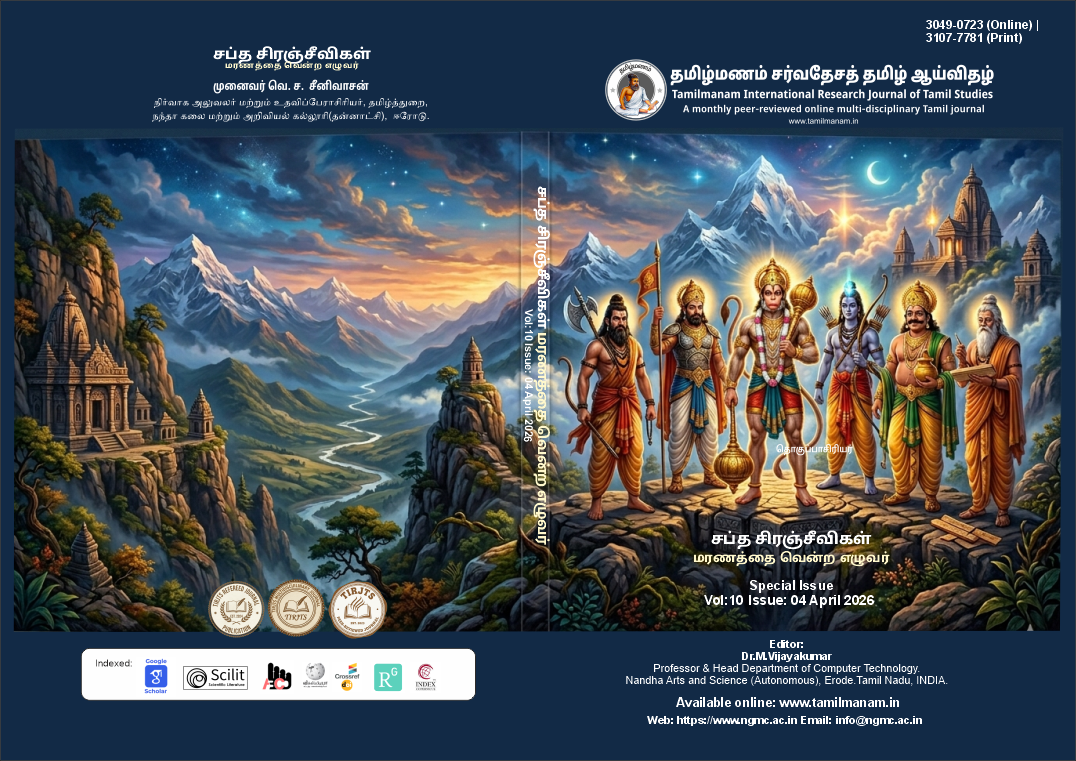
Hanuman, a central character in the Ramayana—the grand epic of Hindu mythology—and the embodiment of devotion, valor, and selfless service, occupies a vital place in the Indian philosophical tradition. As the son of Vayu (the Wind God), he received several divine boons at birth and attained the gift of immortality. Hindu belief holds that Hanuman, one of the seven Chiranjeevis (immortals), resides on Earth until the end of the Kali Yuga. This research paper does not view Hanuman's immortality merely as a mythological event but delves deep into its philosophical foundations.
The initial foundation for Hanuman's immortality was laid during his childhood; when he flew toward the sun mistaking it for a fruit, he was struck by Indra’s Vajrayudha. Following the subsequent wrath of Vayu, Brahma and Indra bestowed boons upon him. Later, in the Uttara Kanda of the Ramayana, before Lord Rama departed for Vaikuntha, he granted Hanuman the boon to "live forever." Thus, Hanuman's immortality is a collective manifestation of various divine powers.
Hanuman’s immortality differs from other Chiranjeevis in many ways. While Ashwatthama wanders in eternal suffering due to a curse, Hanuman received immortality as a reward for his devotion and as the pinnacle of his service to Rama. He also received the boon of "eternal youth." In contemporary society, Hanuman stands as four primary metaphors: the embodiment of selfless service, devotion, valor, and wisdom.
Interestingly, researchers note several similarities between Hanuman and Sun Wukong, the protagonist of the Chinese epic Journey to the West. Scholars like Hu Shih suggest that Hanuman may have been the primary inspiration for the character of Sun Wukong, reflecting the global impact of Indian mythological narratives.
In conclusion, Hanuman’s immortality serves as a philosophical symbol of the supreme state a human can attain through devotion, service, and selflessness. Rather than debating "whether Hanuman still physically exists today," the true essence of his immortality lies in the fact that "his virtues remain alive in our minds today.".
Downloads
References
[1]. iUniverse. (2006). The Divine Anjaneya. iUniverse.
[2]. Nivedita, S., & Coomaraswamy, A. (1913). Myths of the Hindus & Buddhists. Wikisource.
[3]. Lutgendorf, P. (2007). Hanuman's Tale: The Messages of a Divine Monkey. Oxford University Press.
[4]. Hinduism Stack Exchange. (n.d.). Hanuman's immortality boons. Retrieved from https://hinduism.stackexchange.com/
[5]. Bhandari, G. (2004). The Seven Eternal Values. IndiaDivine.org. Retrieved from https://www.indiadivine.org/
[6]. Hinduism Stack Exchange. (n.d.). Rig Veda and Immortality. Retrieved from https://hinduism.stackexchange.com/
[7]. Lutgendorf, P. (2007). Sitings and Sightings: Hanuman in the Cultural Landscape. In Hanuman's Tale: The Messages of a Divine Monkey (pp. 237-298). Oxford University Press.
[8]. OSHO. (n.d.). Inner Being – Manu – Hanuman? OSHO Online Library. Retrieved from https://www.osho.com/
[9]. Nivedita, S., & Coomaraswamy, A. (1913). Myths of the Hindus & Buddhists. Wikisource.
Downloads
Published
Issue
Section
License
Copyright (c) 2026 Dr.P.Gomathi, Dr.V.C.Srinivasan (Author)

This work is licensed under a Creative Commons Attribution 4.0 International License.
Our journal adopts CC BY License Creative Commons Attribution 4.0 International License http://Creativecommons.org//license/by/4.0/ . It allows using, reusing, distributing and reproducing of the original work with proper citation.
