
இந்து தத்துவத்தில் ஜனலோகம்: ஆன்மிகமும் பிரபஞ்சமும்
Jana-loka in Hindu Philosophy: Spirituality and the Universe
DOI:
https://doi.org/10.63300/tm10sp032026.03Keywords:
Jana-loka, Hindu Philosophy, Cosmic Structure, Upanishads, Puranas, Spiritual JourneyAbstract
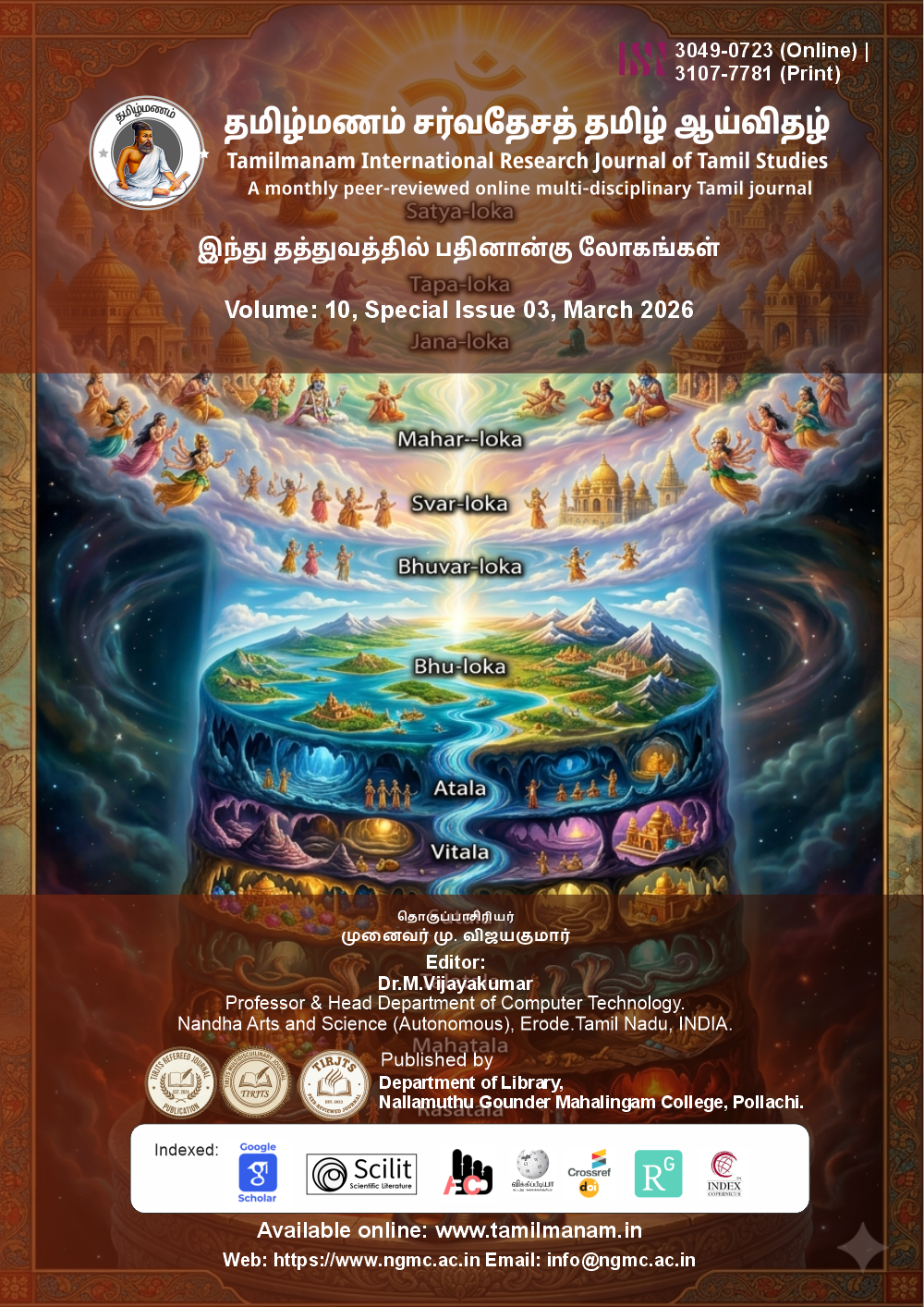
According to Hindu philosophical tradition, the universe is structured in various layers (Lokas). These are categorized into seven upper worlds, ranging from Bhu-loka to Satya-loka, and seven lower worlds. Among these, Jana-loka is considered one of the most exalted realms. According to Vedanta philosophy, this world—situated between the earthly plane and the realm of Brahma—is the abode of sages and saints who have attained high levels of spiritual achievement.
In the Vedas and Upanishads, references to Jana-loka are accompanied by profound theoretical explanations. When the Chandogya Upanishad explains the five fires (Pancha-agni) and the realms attained through them, it depicts Jana-loka as a pinnacle of wisdom. In the Puranas, particularly the Vishnu Purana and the Bhagavata Purana, Jana-loka is described as the residence of the Sanaka Kumaras (the mind-born sons of Brahma). Those who dwell here are portrayed as being liberated from the cycle of birth and fixed in eternal wisdom.
The uniqueness of Jana-loka lies in the fact that it is not just a cosmic location but also a significant goal of human spiritual evolution. It is believed that yogis and ascetics stay in Jana-loka to undergo further purification before reaching the ultimate Brahmanjali in their spiritual journey. This concept explains the progressive stages of the human soul's journey across many lifetimes.
This research article provides a detailed exploration of the philosophical definition of Jana-loka, its mentions in the Vedas and Upanishads, Puranic interpretations, its role in the spiritual journey, and its connection to human life. The paper also discusses Jana-loka’s place within the cosmic structure and how it guides spiritual growth..
Downloads
References
1. உபநிஷத்துகள் – மொழிபெயர்ப்பு மற்றும் விளக்கங்கள்
2. விஷ்ணு புராணம், பகவத புராணம்
3. ராதாகிருஷ்ணன், எஸ். – இந்திய தத்துவம்
4. தாசகுப்தா, சுரேந்திரநாத் – A History of Indian Philosophy
Downloads
Published
Issue
Section
License
Copyright (c) 2026 Dr . M. Ramachandran, Dr.V.C. Srinivasan (Author)

This work is licensed under a Creative Commons Attribution 4.0 International License.
Our journal adopts CC BY License Creative Commons Attribution 4.0 International License http://Creativecommons.org//license/by/4.0/ . It allows using, reusing, distributing and reproducing of the original work with proper citation.
