
இந்து தத்துவத்தில் சுவர்லோகம்: ஆன்மிகமும் பிரபஞ்சமும்
Swar-loka in Hindu Philosophy: Spirituality and the Universe
DOI:
https://doi.org/10.63300/tm10sp032026.05Keywords:
Swar-loka, Hindu Philosophy, Spirituality, Vedas, Karma, UniverseAbstract
In the Hindu philosophical tradition, Swar-loka is not merely a mythological fantasy or a world of pleasure one enters after death. Instead, it is a profound philosophical concept linked to the journey of the human soul. This article explores the conceptual foundations of Swar-loka, its spiritual significance, and its place within the cosmic structure. In the Vedas and Upanishads, Swar-loka is explained not just as a geographical location, but as a higher state of consciousness. It is the state of divine experience that one attains as a result of their virtuous deeds (good karma). It serves as a stepping stone in spiritual evolution. In the Rig Veda, Swar-loka is described as a realm of light, free from all sorrows. Later Puranic texts provided even more detailed descriptions of this realm.
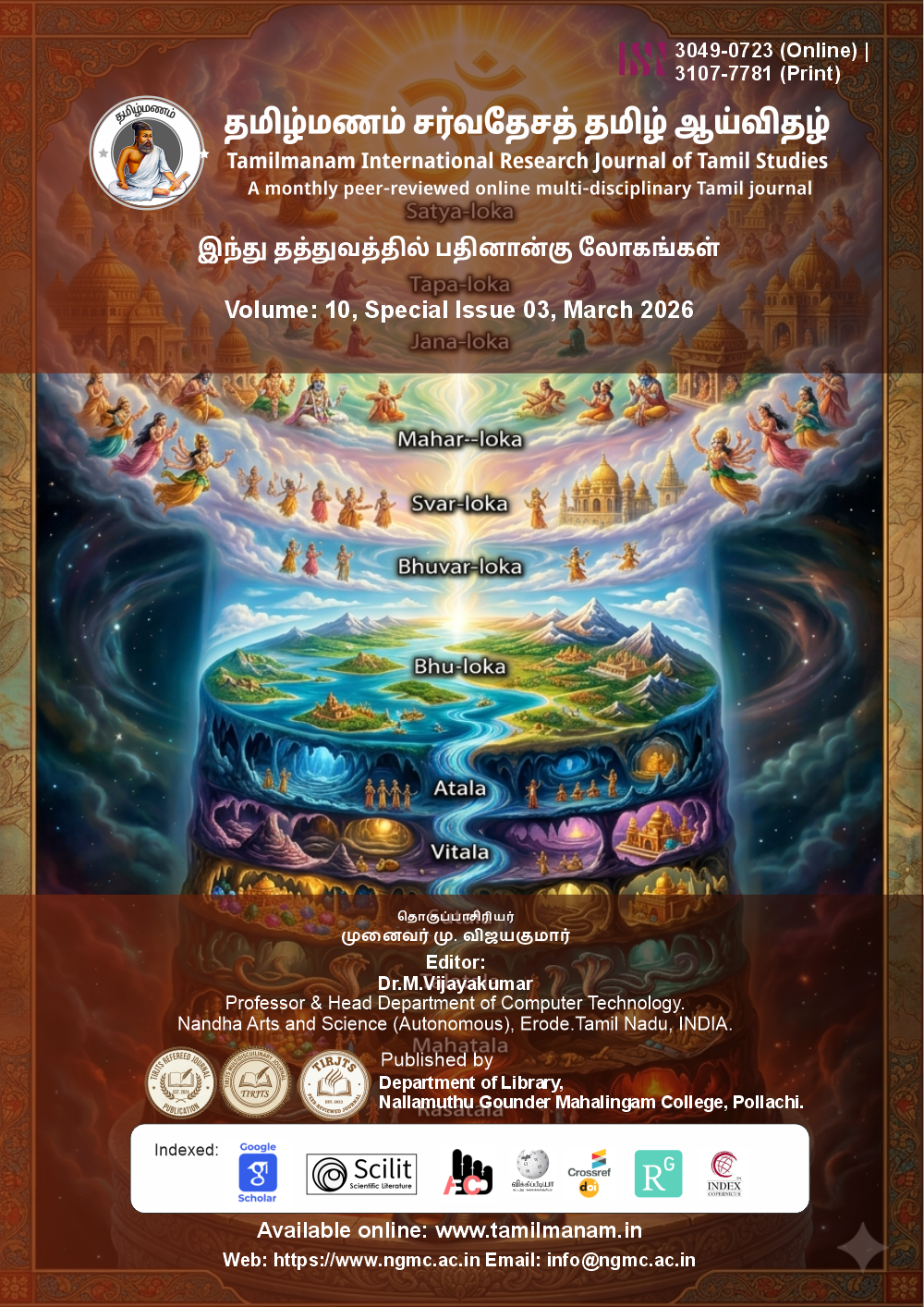
According to Hindu philosophy, the universe is divided into various lokas (planes of existence). There are seven upper worlds: Bhu-loka (Earth), Bhuvar-loka (the intermediate space), Swar-loka (the celestial realm), Mahar-loka, Jana-loka, Tapo-loka, and Satya-loka. Among these, Swar-loka is the third. It is the world of the Devas, ruled by Indra. It is believed that humans who perform righteous deeds reach this realm after death to experience bliss; once their accumulated merit (punya) is exhausted, they return to Earth. From a deeper philosophical perspective, Swar-loka is not an external place. It is the elevation of one's inner consciousness. The blissful experience achieved through states of Yoga and meditation is also personified as Swar-loka. This is intricately woven with the philosophy of Karma. Swar-loka is the fruit attained according to the purity of one's actions. It is not the final destination, but rather an intermediate stage in the spiritual journey toward Mukti (liberation). Traditional explanations of Swar-loka remain relevant in modern times. It serves as a reminder that the goal of human life is not just the pursuit of pleasure, but the attainment of a higher state of being. The concept emphasizes the importance of performing good deeds, helping others, and maintaining spiritual values. According to Hindu philosophy, the true Swar-loka is the mental fulfillment achieved through detachment, showing love toward all living beings, and realizing the Divine.
Downloads
References
1. Loka. (2023). Wikipedia. https://en.wikipedia.org/wiki/Loka
2. Haag, J. W. (2012). Hindu cosmogony/cosmology. In Routledge Encyclopedia of Hinduism. Routledge.
3. Krishnan, S. (2019, July 9). Is karma done in swarga valid? Hinduism Stack Exchange. https://hinduism.stackexchange.com/questions/35612/is-karma-done-in-swarga-valid
4. Kusakratha das Brahmacari. (2010). Brahma Sutras (Govinda Bhashya) (English Translation).
5. Robertson, M. I. (2017). The Religious, Political, and Medical Roots of Personhood in Pre-Classical India (Doctoral dissertation). University of California, Santa Barbara.
6. Vereeniging voor Wijsgeerige Uitgaven. (n.d.). Wereld en hemel in de Veda. Temple University Library.
7. Gonda, J. (1966). Loka: World and heaven in the Veda. Proceedings of the Royal Dutch Academy.
8. Krishnananda, S. (n.d.). Heavenly achievements have no eternal value. In Living a Spiritual Life (Chapter 18). https://www.swami-krishnananda.org/spiritual.life/spiritual_18.html
9. Srimad-Bhagavatam. (n.d.). Canto 4, Chapter 29, Verse 66 (Translation and Purport).
10. Saradananda, S. (2015). From early Hinduism to Neo-Vedanta: Paradigm shifts in sacred psychology and mysticism (Doctoral dissertation). University of South Africa. http://hdl.handle.net/10500/17666
11. Tull, H. (2011). Karma. Oxford Bibliographies. https://www.oxfordbibliographies.com/display/document/obo-9780195399318/obo-9780195399318-0029.xml
12. Svarga. (2015). Tibetan Buddhist Encyclopedia. https://tibetanbuddhistencyclopedia.com/en/index.php/Svarga
13. Pattanaik, D. (2019, January 13). Of hunger in heaven. Mid-day. https://www.mid-day.com/news/india-news/article/Of-hunger-in-heaven-404819
14. Barnett, L. D. (1911). Brahma Knowledge: The After Life. Internet Sacred Text Archive. https://archive.sacred-texts.com/hin/brk/brk28.htm
15. Gonda, J. (1966). Wereld en hemel in de Veda. Tijdschrift Voor Filosofie, 28(2), 227-263.
16. Suargá. (n.d.). Wikipedia, la enciclopedia libre. https://es.wikipedia.org/wiki/Suarg%C3%A1
17. Soifer, D. A. (1991). The Myths of Narasimha and Vamana: Two Avatars in Cosmological Perspective. State University of New York Press.
18. Pintchman, T. (1994). The Rise of the Goddess in the Hindu Tradition. State University of New York Press.
19. Mishra, P. (2024, October 18). Consciousness and creation: Vedic insights versus quantum mechanics. Hindu American Foundation. https://www.hinduamerican.org/blog/consciousness-and-creation-vedic-insights-versus-quantum-mechanics
20. Jhunjhunwala, B. (2021). Hindu cosmology in the light of modern psychology. Ideas Forum International Academic and Scientific Association, 5(9), 19-52.
21. Loka. (2023). Wikipedia. https://en.wikipedia.org/wiki/Loka
Downloads
Published
Issue
Section
License
Copyright (c) 2026 Dr. M. Karthik, Dr. V.C. Srinivasan (Author)

This work is licensed under a Creative Commons Attribution 4.0 International License.
Our journal adopts CC BY License Creative Commons Attribution 4.0 International License http://Creativecommons.org//license/by/4.0/ . It allows using, reusing, distributing and reproducing of the original work with proper citation.
