
இந்து தத்துவத்தில் பூலோகம்: ஆன்மிகமும் பிரபஞ்சமும்
Bhu-loka in Hindu Philosophy: Spirituality and the Universe
DOI:
https://doi.org/10.63300/tm10sp032026.07Keywords:
Bhu-loka, Hindu Philosophy, Spirituality, Universe, Karma, MokshaAbstract
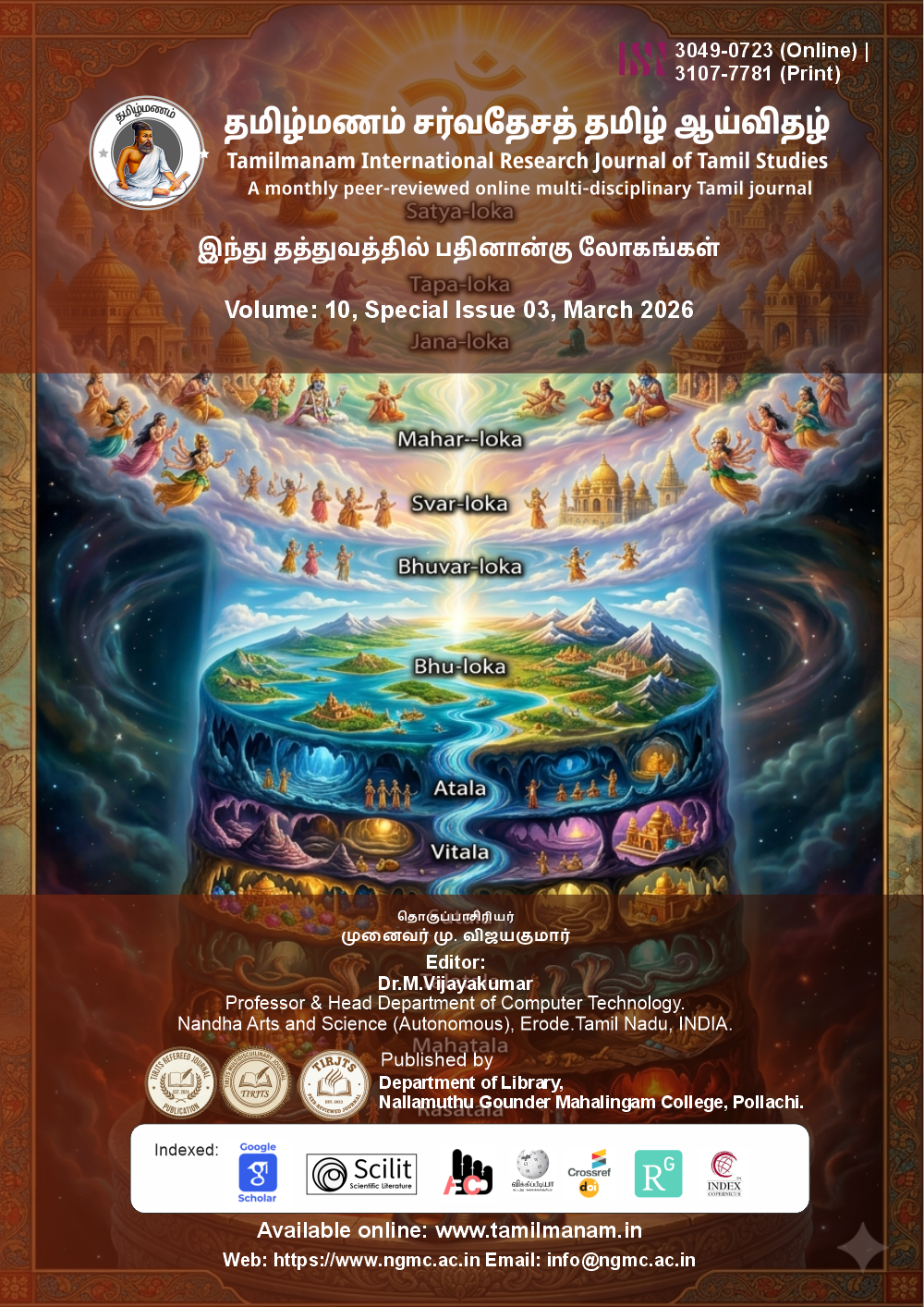
In the Hindu philosophical tradition, the universe is divided into various realms or worlds. Among the fourteen lokas, Bhu-loka is the foremost and the one directly experienced by human beings. Bhu-loka is not merely a physical space; it is a vital training ground for spiritual progress. The Vedas refer to this as "Bhur-loka." It is the abode of all living beings, including humans, animals, plants, and elements.
The unique significance of Bhu-loka lies in the fact that it is the only realm where Karma can be performed (Karma-bhumi). In other worlds, the soul can only experience the fruits of its past actions; it cannot create new karma. Therefore, Bhu-loka is the primary field for spiritual growth. Here, by walking the path of Dharma and performing virtuous deeds, a human can reach higher realms and eventually attain Moksha (liberation).
The Puranas divide Bhu-loka into seven continents (Sapta-dwipa). According to the Srimad Bhagavatam, this realm originated from the feet of the Divine. The Upanishads compare Bhu-loka to the human body—Yatha Pinde Tatha Brahmande (as is the microcosm, so is the macrocosm). The goal of a human living in Bhu-loka is to transcend this physical body and world to reach higher spiritual states.
This research article explores the philosophical foundations of Bhu-loka, its cosmic structure, its role in the spiritual journey, the importance of a life of Dharma, its connection with Karma, and its place in the journey toward Moksha. Based on the Vedas, Upanishads, and Puranas, the meaning and spiritual significance of Bhu-loka are explained in detail.
Downloads
References
1. The worlds (Loka). (2016). Tibetan Buddhist Encyclopedia. https://www.tibetanbuddhistencyclopedia.com
2. Triloka: The three worlds. (1995). Hinduism Today. https://www.hinduismtoday.com
3. Loka. (2023). Wikipedia. https://en.wikipedia.org/wiki/Loka
4. Cosmos in our body. (2014). The Times of India. https://timesofindia.indiatimes.com
5. Chart of Hindu cosmology. (2007). Hinduism Today, 52-53.
6. Fourteen lokas. (2020). Hinduism Stack Exchange. https://hinduism.stackexchange.com
7. Bhagavad Gita. (n.d.). Chapter 2, Verse 47. (S. Radhakrishnan, Trans.). HarperCollins.
8. Bhagavad Gita. (n.d.). Chapter 18, Verses 66. (E. Easwaran, Trans.). Nilgiri Press.
9. Creel, A. B. (1972). Dharma as an ethical category relating to freedom and responsibility. Philosophy East and West, 22(2), 155-168.
10. Frawley, D. (2016). The art and science of Vedic counseling. Lotus Press.
11. Potter, K. H. (1991). Presuppositions of India's philosophies. Motilal Banarsidass.
12. Radhakrishnan, S. (1923). Indian philosophy (Vol. 1). Oxford University Press.
13. Vedadhara. (n.d.). The four Purusharthas: Dharma, Artha, Kama, and Moksha. https://www.vedadhara.com/the-four-purusharthas-dharma-artha-kama-and-moksha
14. Bhagavad Gita. (n.d.). Chapter 2, Verse 47; Chapter 9, Verse 26; Chapter 12, Verse 5. (S. Radhakrishnan, Trans.). HarperCollins.
15. Pujya Swamiji. (2011). Seva & Sadhana – The Paths to the Divine. https://pujyaswamiji.org/seva-sadhana-the-paths-to-the-divine/
16. Theodor, I. (2025). Yoga in the Bhagavad-gītā. In The Philosophy of the Bhagavad-Gita. Cambridge University Press.
17. Yajna. (2022). Wikipedia. https://pt.wikipedia.org/wiki/Yajna
18. Himalayan Institute. (2019). The Path of Love and Devotion in the Gita. https://himalayaninstitute.org/online/the-path-of-love-and-devotion-in-the-gita/
19. Project MUSE. (2019). Worship and Festivals. https://muse.jhu.edu/pub/261/monograph/chapter/2295217/pdf
20. Back to Godhead. (2023). Bhakti: The Only Transcendental Yoga. https://btg.krishna.com/bhakti-the-only-transcendental-yoga/
21. Stanford University. (2024). Synergy of Paths: Exploring the Interplay of Karma, Bhakti, and Jnana in the Bhagavad Gita. SearchWorks.
Downloads
Published
Issue
Section
License
Copyright (c) 2026 Dr. A. Mohanraj, Dr. V. C. Srinivasan (Author)

This work is licensed under a Creative Commons Attribution 4.0 International License.
Our journal adopts CC BY License Creative Commons Attribution 4.0 International License http://Creativecommons.org//license/by/4.0/ . It allows using, reusing, distributing and reproducing of the original work with proper citation.
