
இந்து தத்துவத்தில் தலாதல லோகம்: ஆன்மிகமும் பிரபஞ்சமும்
Talatala-loka in Hindu Philosophy: Spirituality and the Universe
DOI:
https://doi.org/10.63300/tm10sp032026.11Keywords:
Talatala-loka, Hindu Philosophy, Puranas, Cosmology, Mayasura, SpiritualityAbstract
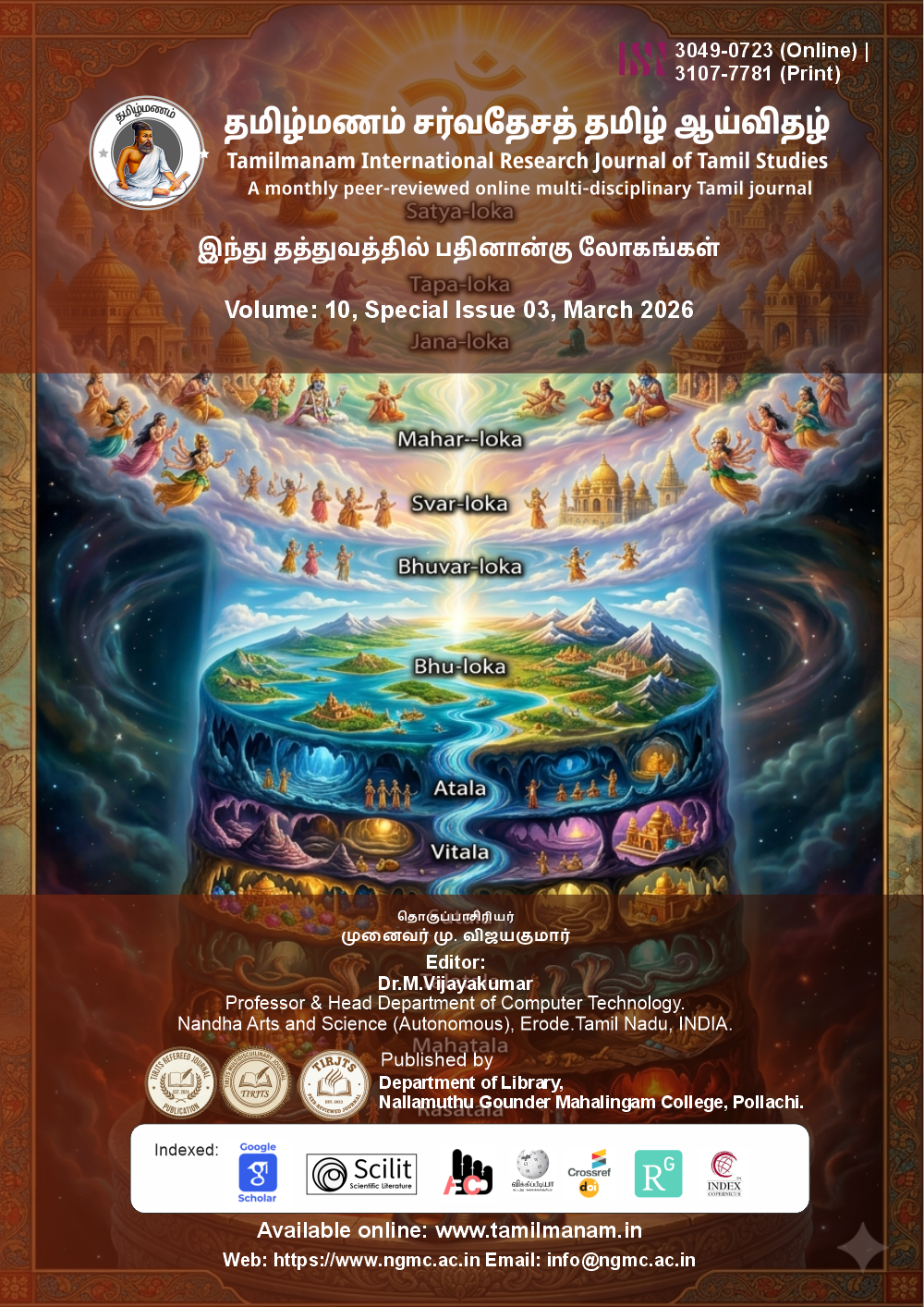
Hindu philosophy explains the universe as a multi-layered structure. According to the Vedas, Agamas, and Puranas, the cosmos is classified into fourteen worlds (Lokas), which are divided into two categories: the upper worlds and the lower worlds. Talatala-loka is identified as the fourth among the seven lower realms.
Mythological accounts describe Talatala-loka as the realm of the powerful king of Asuras, Mayasura. Renowned as the architect of the Asuras, Mayasura was a master of illusions (Maya) and magical powers. The Mahabharata credits him with the construction of the city of Indraprastha (modern-day Delhi). Talatala-loka is characterized as a world of mantras, illusions, and miraculous forces. According to the Vishnu Purana, this realm is situated at a depth of 40,000 yojanas beneath the Earth.
The uniqueness of Talatala-loka lies in its illusory powers. Through his Maya, Mayasura constructed magnificent cities and palaces within this realm, which exist as ever-changing illusory appearances. Although the objects in this world seem real, they are composed of illusion, serving as a symbol of the cosmic force of Maya. From a spiritual perspective, Talatala-loka represents human delusion and enchantment. Mayasura personifies human intellect intertwined with illusory power. This realm signifies the state in which a human becomes trapped in the false appearances of the material world, thereby losing true spiritual consciousness. This research article explores the cosmic structure, mythological descriptions, and spiritual significance of Talatala-loka.
Downloads
References
1. விஷ்ணு புராணம்
2. பாகவத புராணம்
3. கருட புராணம்
4. மகாபாரதம்
5. சுவாமி விவேகானந்தர் – இந்து தத்துவ சொற்பொழிவுகள்
6. Soifer, D. A. (1991). The Myths of Narasimha and Vamana: Two Avatars in Cosmological Perspective. State University of New York Press.
7. Bhagavata Purana. (n.d.). Canto 5, Chapter 24. (Various Translations).
8. Vishnu Purana. (1840). (H. H. Wilson, Trans.). Book II, Chapter V.
9. Māṇi, V. (1975). Purāṇic encyclopaedia: A comprehensive dictionary with special reference to the epic and Purāṇic literature. Motilal Banarsidass.
10. Mayasura. (2025). In Wikipedia. https://en.wikipedia.org/wiki/Maya_Dānava
11. The 7 lower worlds in Hinduism. (2024). Tibetan Buddhist Encyclopedia. https://tibetanbuddhistencyclopedia.com/en/index.php?title=Paatalas
12. Srimad-Bhagavatam. (n.d.). Canto 5, Chapter 24. Bhaktivedanta VedaBase. https://vedabase.io/en/library/sb/5/24/
13. Mayasura. (2025). Grokipedia. https://grokipedia.com/page/Mayasura
14. The 7 lower worlds in Hinduism. (2024). Tibetan Buddhist Encyclopedia.
15. Srimad-Bhagavatam. (n.d.). Canto 5, Chapter 24.
16. Hindu beliefs - The idea of many worlds. (2019). BBC Bitesize.
17. Soifer, D. A. (1991). The Myths of Narasimha and Vamana: Two Avatars in Cosmological Perspective. State University of New York Press.
18. Srimad-Bhagavatam. (n.d.). Canto 5, Chapter 24. Bhaktivedanta VedaBase.
19. Mayasura. (2025). In Wikipedia. https://en.wikipedia.org/wiki/Maya_Dānava
20. Tiripurantaka. (2024). Wisdom Library. https://www.wisdomlib.org/definition/tripurantaka
21. The Third Eye. (2015). Shaivam.org. https://www.shaivam.org/
22. Theosophical Society. (1940). Sanskrit Theosophical Terms and Their Meanings. The Theosophical Forum.
23. Srimad-Bhagavatam. (n.d.). Canto 5, Chapter 24. Bhaktivedanta VedaBase.
24. The 7 lower worlds in Hinduism. (2024). Tibetan Buddhist Encyclopedia.
Downloads
Published
Issue
Section
License
Copyright (c) 2026 Dr. K. Chanthanam, Dr. V.C.Srinivasan (Author)

This work is licensed under a Creative Commons Attribution 4.0 International License.
Our journal adopts CC BY License Creative Commons Attribution 4.0 International License http://Creativecommons.org//license/by/4.0/ . It allows using, reusing, distributing and reproducing of the original work with proper citation.
