தமிழ் பண்பாட்டில் சுற்றுச்சூழல் அறிவும் இயற்கை வழிபாடும்: இந்திய அறிவு மரபுநோக்கு
Ecological Knowledge and Nature Worship in Tamil Culture: An Indian Knowledge Systems (IKS) Perspective
DOI:
https://doi.org/10.63300/tm08sp0126.09Keywords:
Tamil Culture, Ecological Knowledge, Nature Worship, Indian Knowledge System (IKS), Traditional KnowledgeAbstract
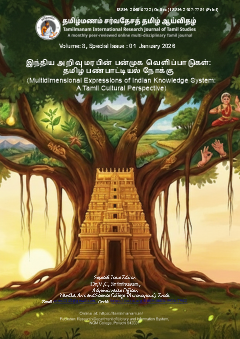
The lifestyle traditions of the Tamils are inherently formed as an integral part of nature. From Sangam literature to subsequent Saivite, Vaishnavite, and folk texts, the prevailing concept is that human life and the environment are inseparable. Here, ecological knowledge is not merely a utilitarian science; it is a shared knowledge acquired through a divine and spiritual relationship. This foundational principle of the Indian Knowledge System (IKS) is deeply rooted in Tamil culture.
In Tamil tradition, the five elements—Land (Earth), Water, Fire, Air, and Sky—along with natural components such as mountains, trees, rivers, animals, and birds, are elevated as powers worthy of worship. The Ainthinai (five eco-regions)—Kurinji, Mullai, Marutham, Neithal, and Paalai—are based on specific ecological systems. The deities of these regions—Murugan, Maayon, Indhiran, Varunan, and Kotravai—are personifications of natural forces.
Practices such as naming a tree 'Kali' and worshipping it, placing horse and elephant statues in Ayyanar shrines, maintaining Naga (serpent) icons at river ghats, and considering the Vanni (Prosopis cineraria) tree as sacred are all external manifestations of nature worship. Such worship mandated a code of conservation within society. It transformed the protection of forests, water bodies, soil, and animals into a social and spiritual duty. Sacred Groves (Kovil Kaadugal) and sacred gardens served as traditional methods for preserving biodiversity.
Therefore, Tamil ecological knowledge and nature worship acted as two sides of the same coin, reinforcing each other. In the face of modern environmental degradation, this traditional knowledge system possesses the potential to provide vital solutions by reclaiming the ethics and values of our relationship with nature.
Downloads
References
1. Balasubramanian, K. "Traditional Environmental Knowledge and Sustainable Living: Practices of Tamil Nadu." Journal of Indian Knowledge Traditions, vol. 2, no. 1, 2018, pp. 45-62.
2. Chelappan, N. "Folk Worship and Environmental Protection." Journal of Folklore Studies, vol. 10, no. 2, 2017, pp. 34-50.
3. Kannappa Mudaliar, R. Philosophical Foundations of Siddha Medicine. Tamil Puthakalayam, 2014.
4. Kasiappan, K. Tamil Agricultural Science: A Historical Perspective. Tamil University, 2002.
5. Narayanan, M., and J. Krishnan. "Environmental Ethics in Traditional Indian Thought." Journal of Ecology and Traditional Knowledge, vol. 5, no. 2, 2021, pp. 112-130.
6. Natarajan, V. Traditional Water Management Methods and Contemporary Challenges. Environmental Foundation, 2020.
7. Parthasarathy, K. "Divine Nature of Tamils: An Ecological Reading." Journal of Tamil Culture, vol. 42, no. 3, 2019, pp. 89-105.
8. Sastri, V. Indian Knowledge Traditions: An Introduction. Center for Indian Knowledge Systems, 2019.
9. Selvaraj, M. "Traditional Knowledge for Sustainability: Practices of Tamil Nadu." Journal of Tamil Science, vol. 15, no. 4, 2021, pp. 23-41.
10. Sethuraman, R. Folk Religions and Environmental Protection. Folk Science Research Center, 2016.
11. Subramanian, C. Nature in Sangam Literature. Saiva Sidhanta Noorpathippu Kazhagam, 1995.
12. Subramanian, S. Environmental Concepts in Tamil Literature. Meiyappan Pathippagam, 2015.
Downloads
Published
Issue
Section
License
Copyright (c) 2026 Dr. S. Manimekalai, Dr.V.C. Srinivasan, Dr. A. Lakshmi Duttai (Author)

This work is licensed under a Creative Commons Attribution 4.0 International License.
Our journal adopts CC BY License Creative Commons Attribution 4.0 International License http://Creativecommons.org//license/by/4.0/ . It allows using, reusing, distributing and reproducing of the original work with proper citation.
How to Cite