
வள்ளுவர் வாக்கியங்களில் காணப்படும் கணித ஒழுங்கும் தர்க்க அமைப்பும்
Mathematical Order and Logical Structure in Valluvar’s Aphorisms
DOI:
https://doi.org/10.63300/tm10sp022026.02Keywords:
Valluvar, Mathematical Order, Logical Structure, Cause-and-Effect, Thirukkural, SequenceAbstract
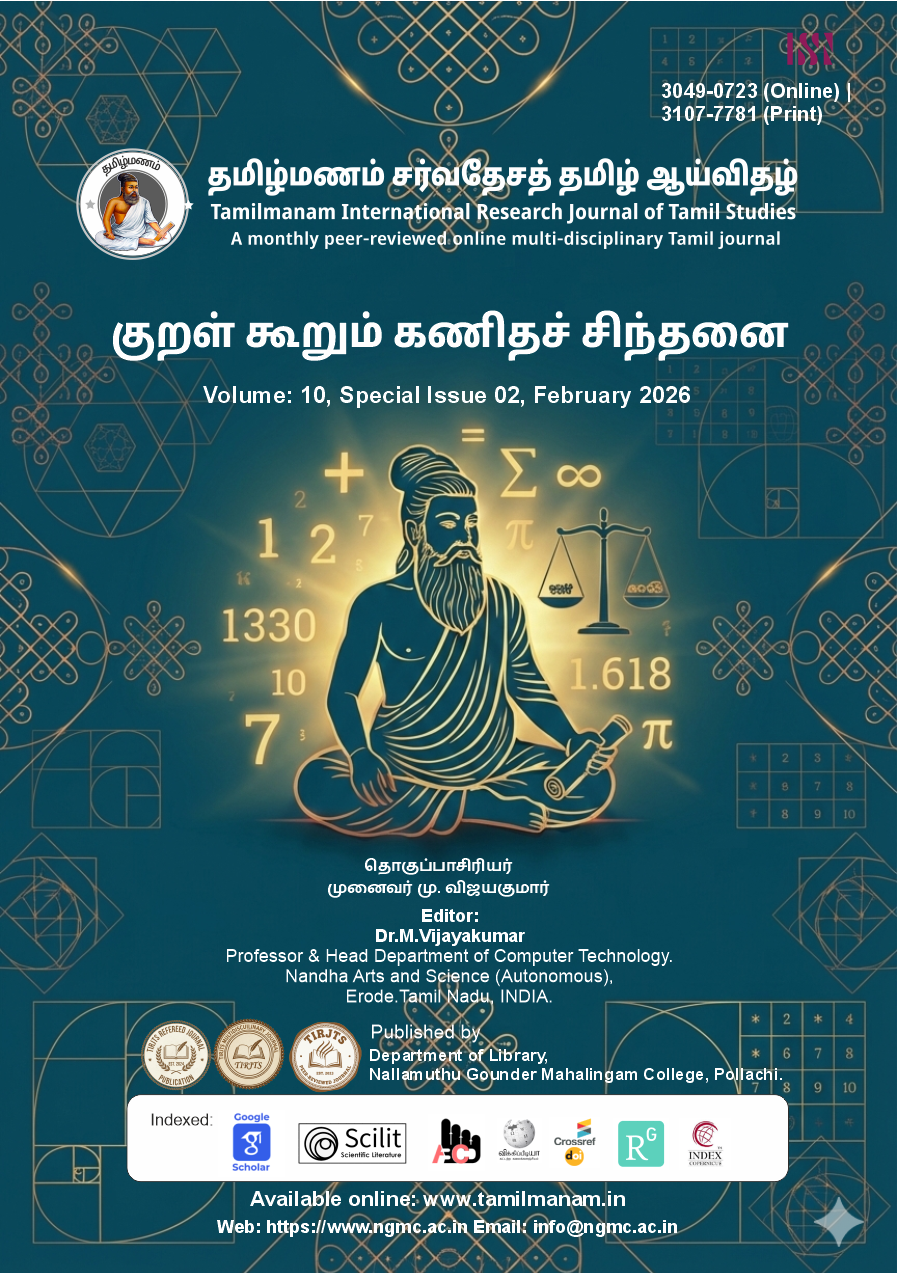
In the Tamil literary tradition, the Thirukkural stands as a masterpiece that integrates logical consistency and scientific thought. The maxims of Thiruvalluvar are not merely moral exhortations; they are built upon a precise mathematical order, logical structure, cause-and-effect relationships, and sequential patterns. This paper analyzes the mathematical framework and logical style inherent in Valluvar's couplets and explains how they align with modern mathematical and logical theories.
Every sentence (couplet) in the Thirukkural functions within a logical framework. Most couplets consist of two lines: the first line posits a premise or action, while the second line provides the explanation or the resulting consequence. This closely resembles the "if-then" logical construct used in mathematics. For instance, the couplet "Ennith thuniga karumam" (First line: Think before you act) and "Thunindhapin ennuvam enbadhu izhukku" (Second line: Thinking after acting is a flaw) creates a complete logical loop. The cause-and-effect relationship is explicitly evident in Valluvar’s verses. He repeatedly emphasizes that every action has a corresponding consequence. The couplet "Nandrangal nallava kaanpavar andrangal allal paduvadhevan" (Kural 378) clearly illustrates the relationship where good deeds yield good results and vice versa, echoing Function Theory in mathematics. Furthermore, a distinct sequential order is found throughout his work. Divided into three sections—Arathuppal (Virtue), Porutpal (Wealth), and Inbathuppal (Love)—the book follows a specific logical progression, reminiscent of Sequence Theory.
The central thesis of this study is that "Each of Valluvar’s couplets is akin to a logical equation; if the first line is the Input, the second line is the Output." Thus, Valluvar’s thought process functions as a well-organized scientific system.
Downloads
References
1. செல்வராஜ், ம. (2019). திருக்குறள் கட்டமைப்பு ஆய்வுகள். சென்னை: பாரதி புத்தகாலயம்.
2. கணேசன், சி. (2020). "திருக்குறளில் சார்புக் கோட்பாடு". தமிழ் மெய்யியல் ஆய்விதழ், 8(2), 45-62.
3. சுந்தரம், க. (2018). திருக்குறள் ஒரு கணிதப் பார்வை. மதுரை: மீனாட்சி புத்தக நிலையம்.
Downloads
Published
Issue
Section
License
Copyright (c) 2026 P. Sathish, Dr. V.C. Srinivasan (Author)

This work is licensed under a Creative Commons Attribution 4.0 International License.
Our journal adopts CC BY License Creative Commons Attribution 4.0 International License http://Creativecommons.org//license/by/4.0/ . It allows using, reusing, distributing and reproducing of the original work with proper citation.
