
இந்து தத்துவத்தில் மஹர்லோகம்: ஆன்மிகமும் பிரபஞ்சமும்
Mahar-loka in Hindu Philosophy: Spirituality and the Universe
DOI:
https://doi.org/10.63300/tm10sp032026.04Keywords:
Hindu Philosophy, Mahar-loka, Universe, Spirituality, Loka Theory, WisdomAbstract
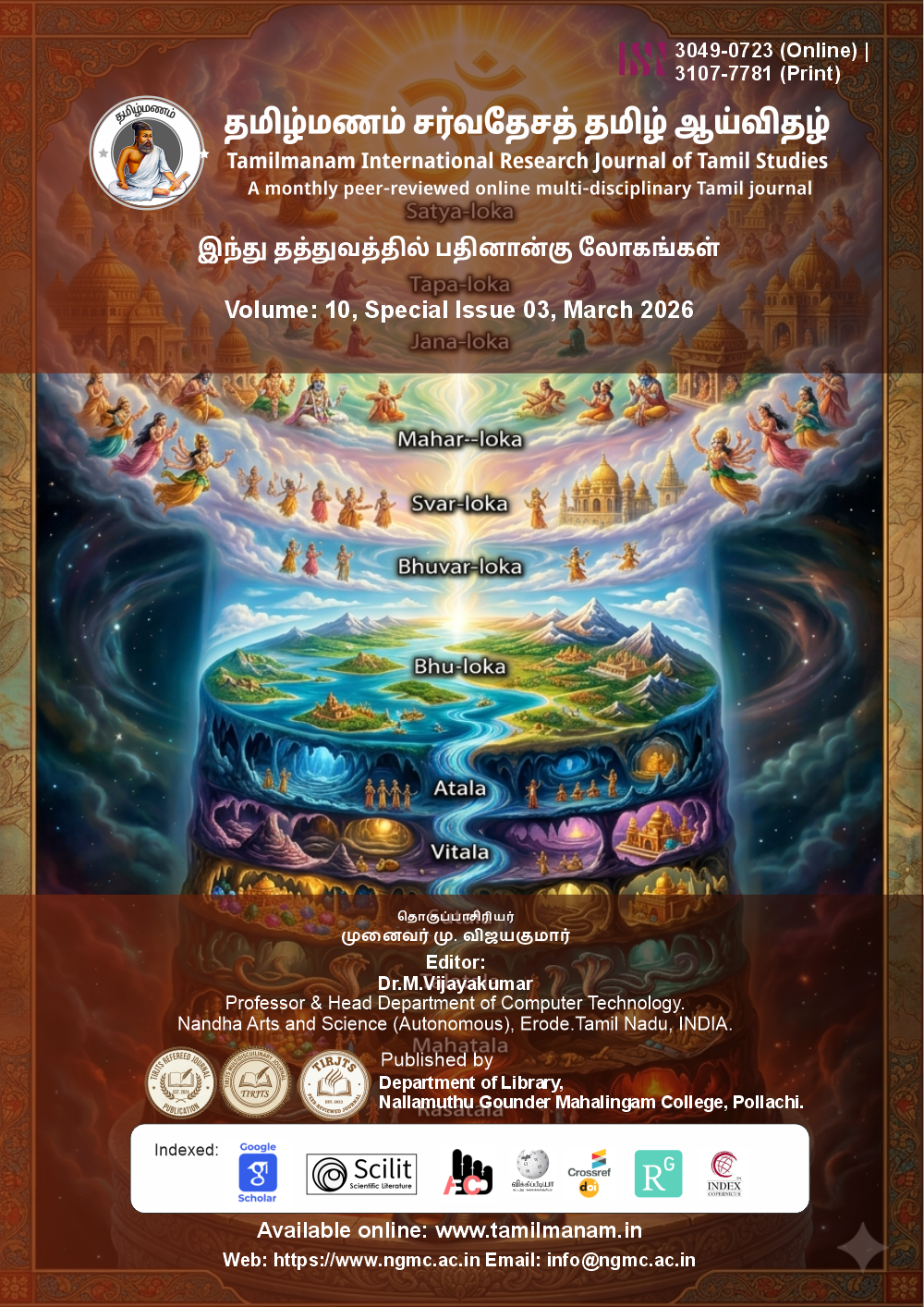
In Hindu philosophy, the universe is explained as a series of progressive stages of spiritual evolution. In this context, Mahar-loka is a high spiritual plane located beyond Bhu-loka, Bhuvar-loka, and Swar-loka. The Puranas describe it as a realm residing beyond human intellect, inhabited by great sages and ascetics (Rishis).
According to Vedic and Upanishadic foundations, Mahar-loka is said to have emerged during the second stage of cosmic creation. The Chandogya Upanishad explains the origin of the universe from a primordial golden egg (Brahmanda), noting that a specific portion of it took form as Mahar-loka.
According to the Puranas, Mahar-loka is situated at a distance of ten million yojanas above the Pole Star (Dhruva Mandala). Those who dwell here remain for the duration of a Kalpa (one day of Brahma) before ascending to even higher realms. A unique feature of this loka is its relative permanence; during the partial dissolution (Pralaya) of the universe, while the three lower worlds (Bhu, Bhuvar, and Swar) are destroyed, Mahar-loka and the realms above it remain intact.
Mahar-loka serves as a vital intermediate stage in the spiritual journey. It is attained through rigorous penance, Vedic sacrifices (Yagyas), and yogic practices. Its inhabitants are those who have conquered their senses and remain steadfast in their devotion to Vishnu. Furthermore, in the microcosmic representation of the human body, Mahar-loka is associated with the throat region, illustrating the profound philosophical principle that the universe and the human body are interconnected (Yatha Pinde Tatha Brahmande).
Ultimately, Mahar-loka is not merely a mythological fantasy but a deep philosophical symbol of the pinnacle of human spiritual growth. The integration of wisdom (Jnana), penance (Tapas), and devotion (Bhakti) paves the way to attaining this exalted state.
Downloads
References
1. உபநிஷத்துகள் – தமிழாக்கமும் விளக்கங்களும்
2. விஷ்ணு புராணம், பகவத புராணம்
3. ராதாகிருஷ்ணன், எஸ். – இந்திய தத்துவம்
4. தாசகுப்தா, சுரேந்திரநாத் – A History of Indian Philosophy
Downloads
Published
Issue
Section
License
Copyright (c) 2026 Mohanraj P,, Dr. V.C.Srinivasan (Author)

This work is licensed under a Creative Commons Attribution 4.0 International License.
Our journal adopts CC BY License Creative Commons Attribution 4.0 International License http://Creativecommons.org//license/by/4.0/ . It allows using, reusing, distributing and reproducing of the original work with proper citation.
