
இந்து தத்துவத்தில் ரஸாதலம்: ஆன்மிகமும் பிரபஞ்சமும்
Rasatala in Hindu Philosophy: Spirituality and the Universe
DOI:
https://doi.org/10.63300/tm10sp032026.13Keywords:
Rasatala, Hindu Philosophy, Puranas, Cosmology, Asuras, SpiritualityAbstract
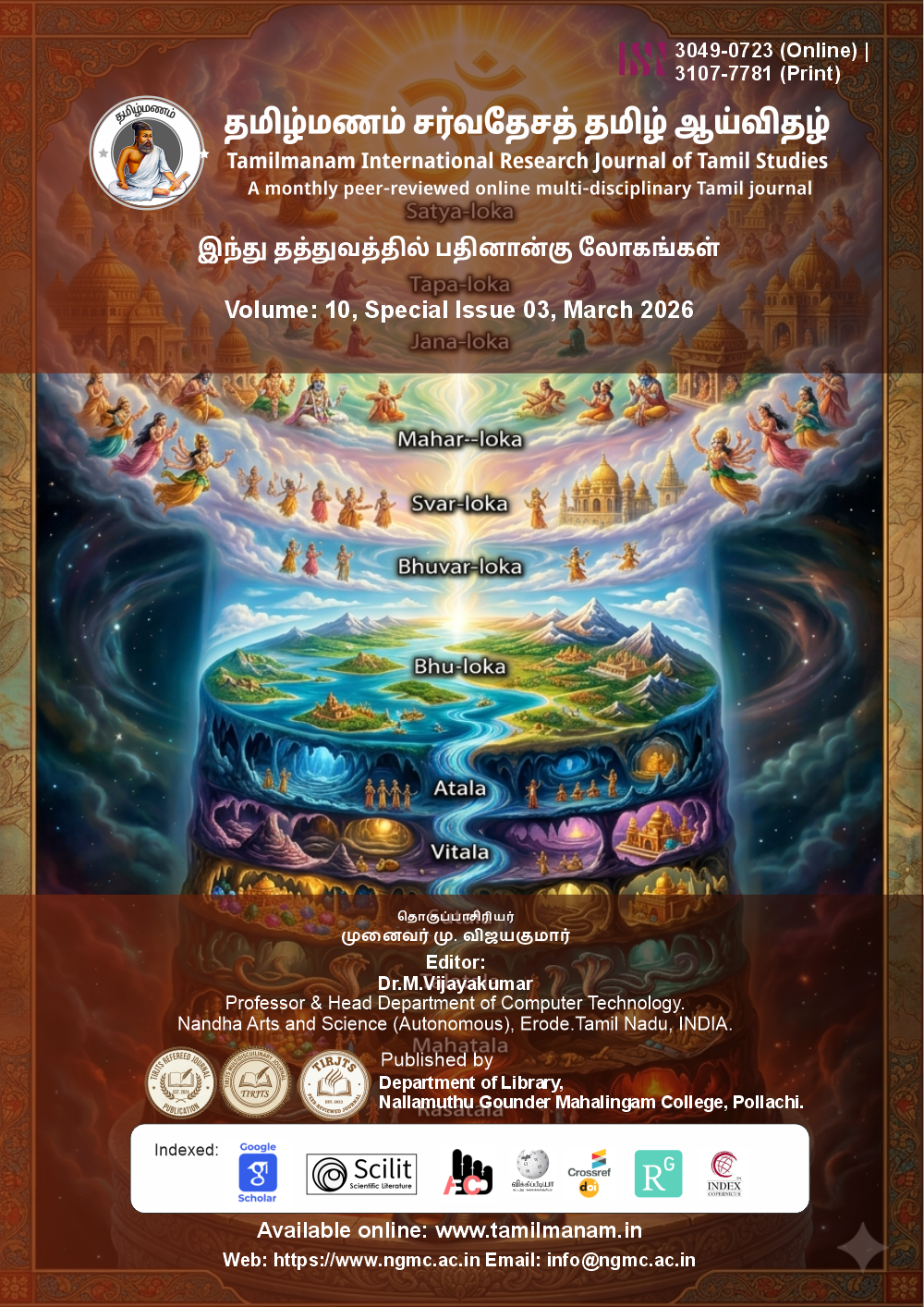
In the Hindu philosophical tradition, the universe is explained as a multi-layered structure. The Vedas, Agamas, and Puranas classify the cosmos into fourteen worlds (Fourteen Worlds). These are divided into two major sections: seven upper worlds and seven lower worlds. Among the lower realms, Rasatala is identified as the sixth world.
In Hindu mythology, Rasatala is described as a mystical cosmic layer inhabited by Asuras and Daityas. According to the Vishnu Purana and Bhagavata Purana, various clans such as the Daityas, Danavas, Kalakeyas, and Nivata-kavachas reside here. They possess immense strength and illusory powers (Maya). Despite their power, they are frequently depicted as being in conflict with the Devas to showcase their prowess.
At the same time, Rasatala is also characterized as a realm of immense wealth and miraculous cities. It contains magnificent urban structures built by divine architects like Maya and palaces filled with precious gemstones. The Vishnu Purana describes this world by stating that although it appears dark from the outside, it is filled with great light and prosperity within.
From a spiritual perspective, Rasatala is considered a symbol of human ego and arrogance. Although the Asuras dwell in this world, they are eventually overcome by divine grace. This serves as a reminder that humans must also conquer their ego to achieve spiritual elevation. This research article explores the position of Rasatala in Hindu philosophy, its cosmic structure, mythological stories, and its spiritual significance.
Downloads
References
1. Bhagavata Purana. (n.d.). Canto 5, Chapter 24. (Various Translations).
2. Brahma Purana. (n.d.). Chapter 21. (Surabhi H. Trivedi, Trans.).
3. Vishnu Purana. (1840). (H. H. Wilson, Trans.). https://sacred-texts.com/hin/vp/
4. Klostermeier, K. K. (2001). Piccola enciclopedia dell'Induismo. Edizioni Arkeios.
5. Māṇi, V. (1975). Purāṇic encyclopaedia: A comprehensive dictionary with special reference to the epic and Purāṇic literature. Motilal Banarsidass.
6. Mahabharata. (n.d.). Santiparva Section.
7. The Hindu. (2020, October 4). Yagna Varaha. https://www.thehindu.com/society/faith/yagna-varaha/article32766959.ece
8. Hiranyaksha. (2025). In Wikipedia. https://en.wikipedia.org/wiki/Hiranyaksha
9. Avatara: Divine Descent. (n.d.). Asia Society. https://sites.asiasociety.org/chola/exhibit/avatara
10. Varaha. (2024). In WisdomLib.org. https://www.wisdomlib.org/concept/varaha
11. Dashavtar Comic, Varaha Avatar. (2013). HKTV. https://hktv.in/video/dashavtar-comic-varaha-avatar-the-boar-incarnation/
12. Hinduism Stack Exchange. (2022). How did the Varaha Avatar take out the earth from the sea? https://hinduism.stackexchange.com/questions/53509/how-did-the-varaha-avatar-took-out-the-earth-from-the-sea
13. The Secrets of Sanatan Vigyan. (2024, September 21). He Who Rescued Mother Earth. LinkedIn.
14. Bhagavata Purana. (n.d.). Canto 5, Chapter 24.
15. Devi Bhagavatam. (n.d.). Eighth Book, Chapter 20.
16. Kinđić, Z. (2010). The problem of evil in Hinduism. Filozofija i društvo, 209-224.
17. Wisdom Library. (2024). Rasatala: 20 definitions.
18. Kamakoti Peetham. (n.d.). Bhagvatpurana part 5.
19. Vedabase. (n.d.). ŚB 5.24.30
20. Shadowmaya. (2014). Atala, Vitala, Sutala, Talatala, Rasatala, Mahatala, Patala [Online forum post]. Andhrafriends.com. https://www.andhrafriends.com/topic/550759-confusion-athala-vithala-suthala-thalaathala-rasaathala-paathaala/
21. Srimad-Bhagavatam. (n.d.). Canto 4, Chapter 29, Verse 28. (A.C. Bhaktivedanta Swami Prabhupada, Trans.). Bhaktivedanta Book Trust. https://www.vaniquotes.org/
22. Srimad-Bhagavatam. (n.d.). Canto 5, Chapter 24. Bhaktivedanta VedaBase. https://vaniquotes.org/
23. Wisdom Library. (2024). Rasatala: 20 definitions. WisdomLib.org. https://www.wisdomlib.org/definition/rasatala
Downloads
Published
Issue
Section
License
Copyright (c) 2026 Dr. C. Sakthimurugan, Dr. V. C. Srinivasan (Author)

This work is licensed under a Creative Commons Attribution 4.0 International License.
Our journal adopts CC BY License Creative Commons Attribution 4.0 International License http://Creativecommons.org//license/by/4.0/ . It allows using, reusing, distributing and reproducing of the original work with proper citation.
