
இந்து தத்துவத்தில் மஹர்லோகம்: ஆன்மிகமும் பிரபஞ்சமும்
Bhuvar-loka in Hindu Philosophy: Spirituality and the Universe
DOI:
https://doi.org/10.63300/tm10sp032026.06Keywords:
Bhuvar-loka, Hindu Philosophy, Spirituality, Karma, Reincarnation, UniverseAbstract
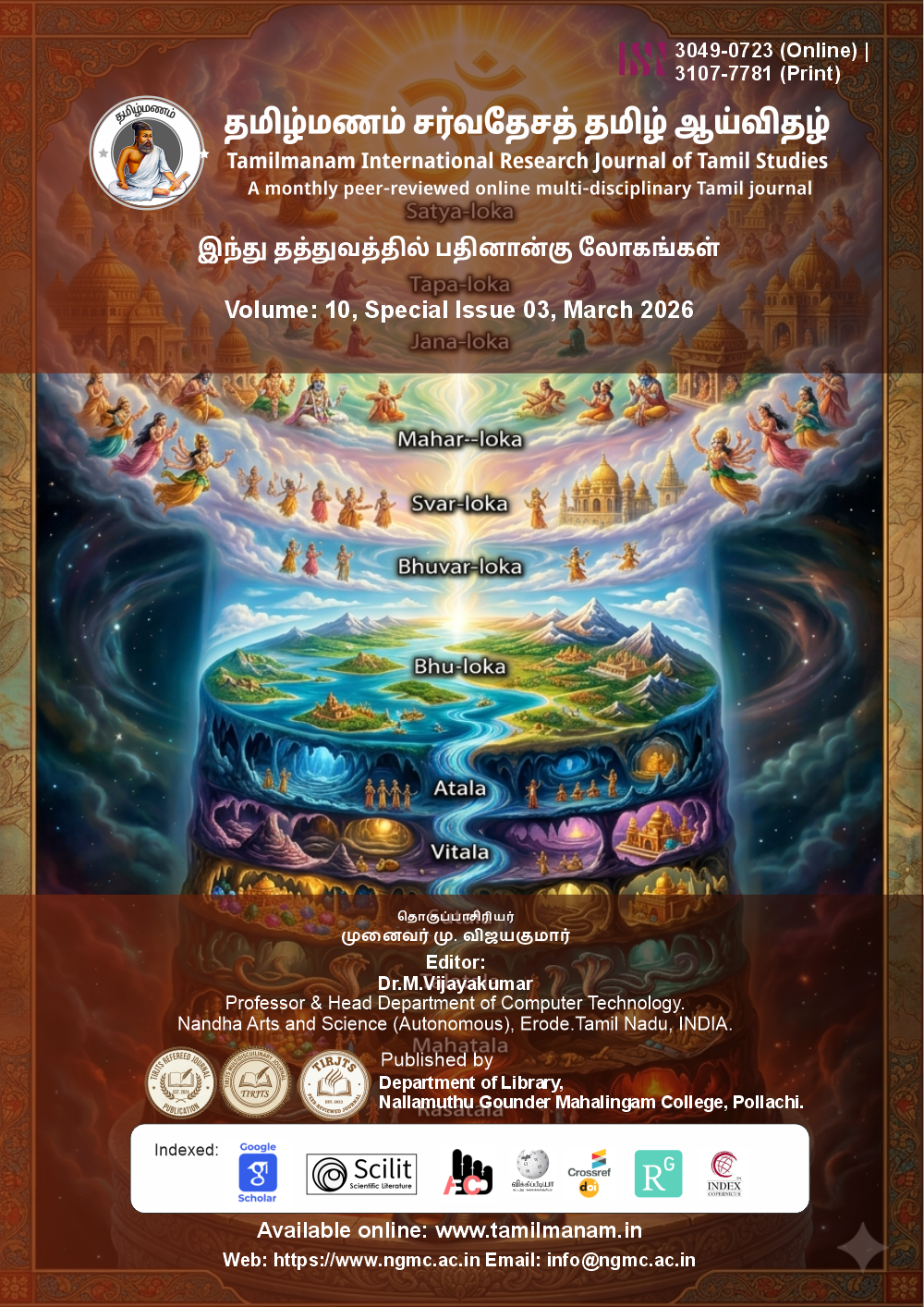
In the Hindu philosophical tradition, Bhuvar-loka is explained as a crucial intermediate world situated between the earthly realm (Bhu-loka) and the higher divine realms. It is not merely a geographical or imaginary world; rather, it is a philosophical concept deeply connected to the journey of the soul, the doctrine of Karma, reincarnation, and the cosmic structure. In Vedic literature, the term Loka signifies a sacred, valued space—a secure, luminous place where one can connect with divine forces (Gonda, 1966). In the list of the fourteen worlds, Bhuvar-loka stands as the second of the upper worlds, representing the atmospheric space between Earth and the celestial realm (Swar-loka). Bhuvar-loka is described as a transitional plane. Here, souls exist in a state prior to ascending to higher realms or descending to lower ones, depending on their karmic fruits. It is also referred to as the "atmospheric region" (antariksha). According to the Puranas, the Pitrus (ancestors) reside here, and the Moon is considered the presiding deity of this loka. Following the doctrine of Karma, once a person passes away, their soul first reaches Bhuvar-loka. Based on the nature of their actions, they may proceed to higher worlds or be pulled to lower ones; thus, it serves as a sort of filtration stage (Tull, 1989). In the Upanishads, Bhuvar-loka is also called "Chandra-loka" (the realm of the moon). Those who have performed virtuous deeds go there to experience the fruits of their merit (punya), and after exhausting those merits, they return to Earth with their remaining karmic imprints (Prashna Upanishad 1.9-10). True sages, however, transcend this state to attain Brahman.The study of Bhuvar-loka helps in understanding the journey of the soul between birth and rebirth in Hindu philosophy. It acts as a bridge between the physical and spiritual worlds. In modern psychology, this can be compared to an intermediate state where one's level of consciousness undergoes a transition (Jhunjhunwala, 2021).
Ultimately, Bhuvar-loka is not just a mythological fantasy but a profound philosophical concept explaining the soul’s journey, the consequences of Karma, and the hierarchical structure of the universe.
Downloads
References
1. Krishnananda, S. (1982, April 18). Question and Answer Session 3. The Divine Life Society. https://www.swami-krishnananda.org/disc/disc_318.html
2. Soifer, D. A. (1991). The Myths of Narasimha and Vamana: Two Avatars in Cosmological Perspective. State University of New York Press.
3. The 7 lokas mentioned in Hindu scriptures and legends. (2024, July 21). The Times of India. https://timesofindia.indiatimes.com/life-style/soul-search/the-7-lokas-mentioned-in-hindu-scriptures-and-legends/photostory/111890572.cms
4. Philosophy of bhagawad-gita. (1911). Wikisource. https://en.wikisource.org/wiki/Page:Philosophy_of_bhagawad-gita.pdf/57
5. Various Lokas. (2017, December 21). Speaking Tree. https://www.speakingtree.in/blog/various-lokas
6. Gonda, J. (1966). Loka: World and Heaven in the Veda. Noord-Hollandsche Uitgevers Maatschappij.
7. Krishnananda, S. (1982, April 18). Question and Answer Session 3. The Divine Life Society. https://www.swami-krishnananda.org/disc/disc_318.html
8. Soifer, D. A. (1991). The Myths of Narasimha and Vamana: Two Avatars in Cosmological Perspective. State University of New York Press.
9. Srimad-Bhagavatam. (n.d.). Canto 2, Chapter 5, Verse 42. Bhaktivedanta VedaBase. https://vedabase.io/en/library/sb/2/5/42/
10. The 7 lokas mentioned in Hindu scriptures and legends. (2024, July 21). The Times of India. https://timesofindia.indiatimes.com/life-style/soul-search/the-7-lokas-mentioned-in-hindu-scriptures-and-legends/photostory/111890572.cms
11. The Mother & Sri Aurobindo. (n.d.). Bhuvar Bhuvah Bhuvarloka. https://motherandsriaurobindo.in/
12. Sri Sathya Sai Baba. (1968). The Fourteen Worlds (Prasnothara Vahini). Sri Sathya Sai Books and Publications Trust. https://saispeaks.sathyasai.org/discourse/fourteen-worlds
13. The Mother & Sri Aurobindo. (n.d.). Bhuvar Bhuvah Bhuvarloka. The Mother & Sri Aurobindo e-library. https://motherandsriaurobindo.in
14. Hindu cosmology chart. (2007, July/August/September). Hinduism Today, 52-53. https://www.hinduismtoday.com
Downloads
Published
Issue
Section
License
Copyright (c) 2026 Dr. P.Gomathi , Dr. V.C. Srinivasan (Author)

This work is licensed under a Creative Commons Attribution 4.0 International License.
Our journal adopts CC BY License Creative Commons Attribution 4.0 International License http://Creativecommons.org//license/by/4.0/ . It allows using, reusing, distributing and reproducing of the original work with proper citation.
