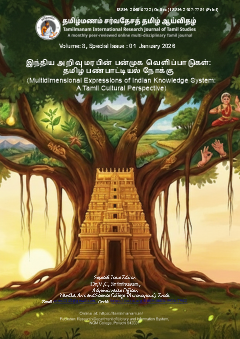
தமிழ் கோயில் பண்பாட்டில் இந்திய அறிவுமரபு: ஆகமம், கலை, சமூகஒழுங்கு
Indian Knowledge Tradition in Tamil Temple Culture: Agamas, Art, and Social Order
DOI:
https://doi.org/10.63300/tm08sp0126.07Abstract
Tamil temple culture is a complex and integrated expression of the Indian knowledge tradition. Transcending the definition of mere places of worship, these temples serve as a confluence of philosophy, art, social organization, and scientific precision. At the foundation of this temple culture lie the Agamas—scriptures that provide detailed and subtle guidelines for architecture, iconography, sanctum layout, and daily ritualistic practices. These Agamic principles posit that the Divine is not an external or merely formal force, but an immanent power of the universe. Consequently, the temple is conceptualized as a 'Microcosm' that structures these cosmic energies to make them accessible to human experience.
This philosophical foundation is vividly manifested in Dravidian architecture and sculpture. The structural elements—the Gopuram (gateway tower), Vimana (tower over the sanctum), Mandapam (hall), and Garbhagriha (sanctum sanctorum)—are often compared to the chakras (energy centers) of the human body and cosmic movements. Through wall sculptures, pillar carvings, and dance mudras, temples record not only Ithihasa and Puranic narratives but also elements of astronomy, mathematics, and natural sciences.
Thirdly, the temple functioned as a socio-economic hub. It served as a central node for education (schools), the arts (dance and music), social services (charity houses and water management), and economic activities (industry and trade). Through these functions, temple culture evolved into a system for maintaining social order, where spiritual and secular lives merged seamlessly. Therefore, understanding Tamil temple culture offers an opportunity to explore how the Indian knowledge tradition transformed into a Holistic Life-System for society.
Keywords:
Tamil Temple Culture, Indian Knowledge Tradition, Agama, Dravidians Architecture, Temple Social Structure, Social OrderDownloads
References
1. Sivaprakasam, N. (2005). Tamil Temples and Agamic Traditions. Thanjavur: Tamil University.
2. Rajam, K.V. (2011). Socio-Economics of Temples during the Chola Period. Chennai: Poorani Pathippagam.
3. Sivaprakasam, N. (2005). Tamil Temples and Agamic Traditions. Thanjavur: Tamil University.
4. Parthasarathy, K. (2010). Agamas: History and Worship Methods. Chennai: Saraswathi Mahal.
5. Srinivasan, P. (1998). The Philosophy of Temple Sculpture in Tamil Nadu. Chennai: Kalaikalanjiyam.
6. Sundaram, S. (2003). Thevaram Music and Temple Culture. Journal of the Sangeet Natak Akademi, 45(2), 78-95.
7. Subramanian, K. (2008). Educational Institutions of the Chola Period. Chennai: Palaniappa Pathippagam.
8. Seshadri, A. (2012). Socio-Economic History in Temple Inscriptions. Thanjavur: Tamil University Publication.
9. Subramanian, K.S. (2010). Temple Education and Knowledge Dissemination Methods. Chennai: Meiyappan Pathippagam.
10. Sivaramakrishnan, V. (2014). Traditional Healing Methods and Rituals of Tamils. Journal of Ayurveda Research, 12(1), 34-52.
11. Sivaprakasam, N. (2005). Tamil Temples and Agamic Traditions. Thanjavur: Tamil University.
12. Srinivasan, P. (1998). The Philosophy of Temple Sculpture in Tamil Nadu. Chennai: Kalaikalanjiyam.
13. Rajam, K.V. (2011). Socio-Economics of Temples during the Chola Period. Chennai: Poorani Pathippagam.
Downloads
Published
Issue
Section
License
Copyright (c) 2026 DR R. Sengottuvel, Dr.V.C. Srinivasan, Dr. A. Lakshmi Duttai (Author)

This work is licensed under a Creative Commons Attribution 4.0 International License.
Our journal adopts CC BY License Creative Commons Attribution 4.0 International License http://Creativecommons.org//license/by/4.0/ . It allows using, reusing, distributing and reproducing of the original work with proper citation.
How to Cite