
Vol. 7 No. 03 (2026): Tamilmanam March 2026
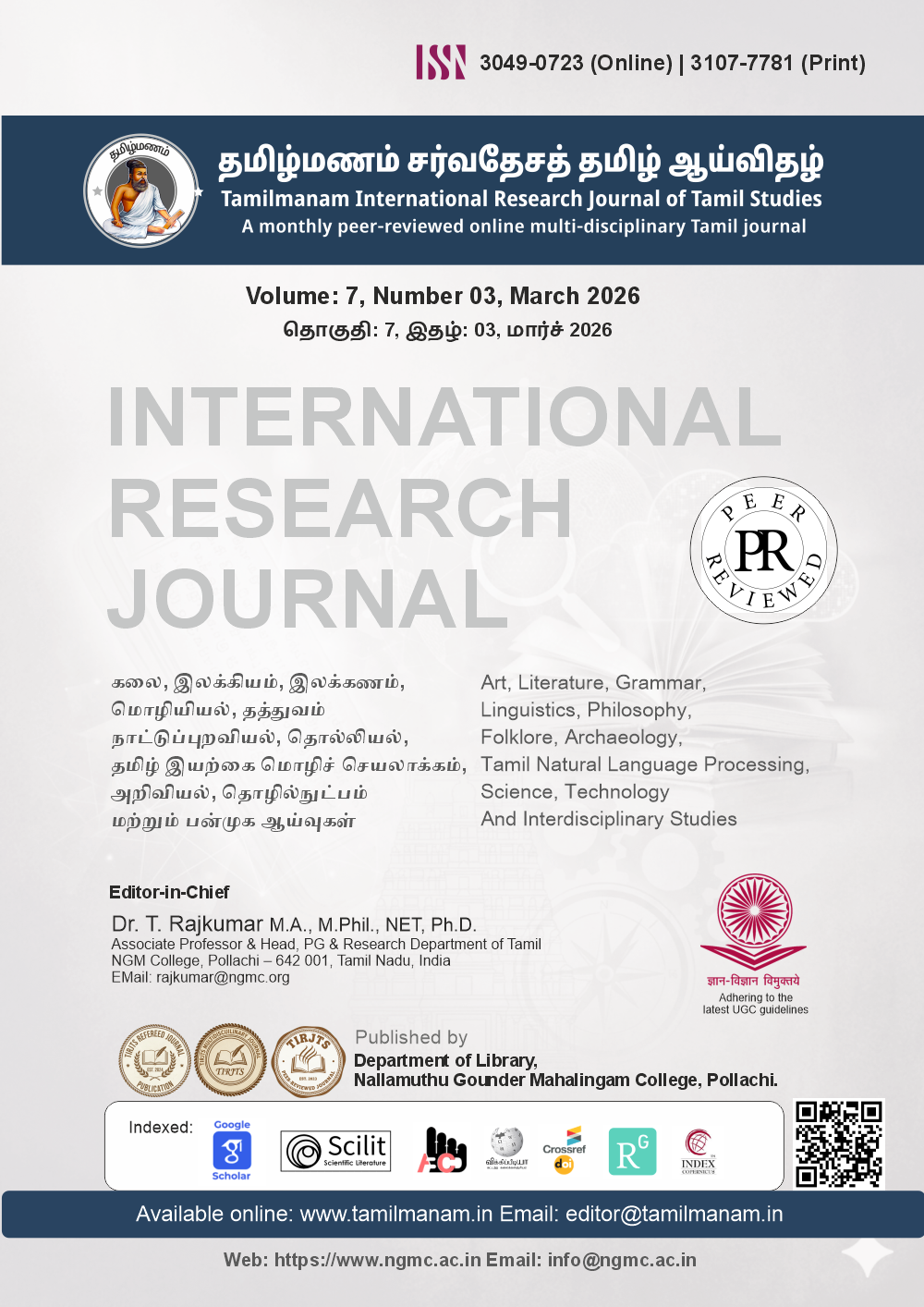
Full Issue
Articles
-
சங்க இலக்கியத்தில் மனவியல் கோட்பாடுகள்: தொல்காப்பியம் முதல் புறநானூறு வரை ஒரு பன்முக ஆய்வு Psychological Principles in Sangam Literature: A Multidimensional Study from Tolkappiyam to Purananuru
D.Gomathi Tamil Teacher, SNS Academy, Thudiyalur - Saravanampatti Road, Vellakinar Post, Coimbatore - 641029. IndiaThe Sangam period is considered the most ancient and fertile era in the history of Tamil literature. The literary works of this period have deeply recorded various dimensions of human life, particularly the intricacies of psychological emotions. This research paper provides a comprehensive analysis by comparing emotional expressions, social relationships, the attitudes of women, the link between nature and mental states, valor, and ethics in Sangam poetry with modern psychological theories. Specifically, it explains how the Ainthinai (five landscapes) system and the Akam-Puram classification established in Tolkappiyam serve as frameworks reflecting the human mental structure.
The romantic bonds depicted in Akam poems are comparable to contemporary 'Attachment Theory' and 'Separation Anxiety'. Furthermore, Puram poems provide an understanding of 'Social Identity' and 'Leadership Psychology'. Through the lens of 'Ecopsychology', the paper deeply analyzes how nature functions as a symbol of human mental states and how the 'Aram'-based (ethical) lifestyle of the Sangam Tamils provided a foundation for mental well-being.
Pages: 573-581Views: 372 Downloads: 298தமிழர் மருத்துவத்தின் பழமையும் தனித்தன்மையும் The antiquity and uniqueness of Tamil medicine
Riya Raja K Govt Girls HSS, Karamana, Trivandrum IndiaTraditional Tamil medicine is an ancient system deeply rooted in lifestyle knowledge, nature, and local flora. Classical Sangam literature, Thirumandiram, and Siddha texts document its rich history, highlighting how plant leaves, roots, and bark were tailored for health remedies. Tamil literature evidences sophisticated early medical concepts, including battlefield wound care using cotton dressings, thread suturing, and surgical interventions documented in texts like Pathitrupathu and Purananuru. Works like Tirukkural, Tirigadugam, and Sirupanchamoolam emphasize holistic principles-diagnosing root causes, regulating diet, and utilizing natural remedies like pepper, ginger, and neem. Centered on the philosophy "Food is medicine, medicine is food," Tamil medicine prioritizes disease prevention, physical well-being, and eco-friendly practices. Because its remedies act as natural extensions of food, the system offers effective treatment without side effects, reflecting a timeless, sustainable approach to health and longevity.Pages: 1039-1046Views: 14 Downloads: 4திருக்குறளில் கல்லாமை: நவீன மூளை நரம்பியல் மற்றும் அறிவாற்றல் அறிவியலின் அடிப்படையில் ஒரு விரிவான ஆய்வு "Kallaamai" (Illiteracy) in Thirukkural: A Comprehensive Study Based on Modern Neuroscience and Cognitive Science
Prof. Dr. M. A. Aleem Neurologist Dhanalakshmi Srinivasan Medical College, Siruvachur and ABC Hospital, Trichy. IndiaThis research paper comprehensively examines the concept of 'Kallaamai' (Illiteracy - Chapter 41), articulated by Thiruvalluvar over two thousand years ago, through the lens of modern Neuroscience, Cognitive Psychology, and Global Health Policies. Instead of viewing illiteracy merely as a social or economic deficiency, this article elucidates its intricate connections with human Neural Plasticity, Prefrontal Cortex (PFC) functions, and age-related Cognitive Decline.
Specifically, drawing upon data from the Lancet Commission 2024 report, this paper establishes how education builds a 'Cognitive Reserve' that safeguards individuals against neurological conditions such as Dementia. By juxtaposing the metaphors present in Kurals (couplets) 401, 402, 403, and 410 with findings from modern Neurochemistry, hormonal functions (Oxytocin), and Evolutionary Biology, this study offers a scientific rereading of Valluvar's profound insight.
Pages: 582-590Views: 239 Downloads: 230சன்மதக் கடவுள்களின் ஊர்தி சின்னங்கள் மற்றும் பரதநாட்டிய ஹஸ்தப் பயன்பாடுகள்: ஆகமம், சாஸ்திரம் மற்றும் அபிநய மரபுகளின் ஓர் ஆய்வு The Life Philosophies and Traditional Worship Practices of the Sanmarga Communities: A Study in the Context of Agam, Shaivism, and Arya Traditions.
Ms. Himarthika Thulasithasan Temporary Assistant Lecturer in Bharathanatyam, Department of Dance, Drama & Theater, Swami Vipulananda Institute of Aesthetic Studies, Eastern University, Sri Lanka. Sri LankaThis study examines the life philosophies and traditional worship practices of the Sanmarga communities in the Indian subcontinent from a broad analytical perspective. It explores the ritual methods, Agamic foundations, Shaiva practices, and their religious, spiritual, and social dimensions. The study investigates the ritual traditions followed in worship and the foundational beliefs associated with them. It analyzes how these ritual practices are structured and how they are carried out in accordance with Agamic principles. In particular, it examines how ritual systems and their procedural practices are organized based on Shaiva religious texts. Furthermore, the research highlights how, through ritualistic worship methods, various spiritual codes and symbolic expressions have been shaped within religious traditions. It also discusses how the ritual procedures established by Natyacharyas and other scholars have been structured within worship traditions. In addition, it explores how ritual and performance traditions were formed through the contributions of religious scholars and teachers. This study concludes that these ritual practices serve as foundational elements in developing art, religion, spirituality, and social expression.
பரதநாட்டிய ஹஸ்தப் பிரயோகங்கள் மூலம் எவ்வாறு வெளிப்படுத்துகின்றனர் என்பதைக் கருத்தாய்வு செய்கிறது. இந்த ஆய்வு சன்மதக் கடவுள்களின் ஊர்தி அடையாளங்களின் புராண, ஆகம, சாஸ்திர அடிப்படைகளையும், அவற்றின் கலை வடிவ மாற்றங்களையும் ஆராய்கிறது. குறிப்பாக பரதநாட்டியத்தில் பிரயோகங்கள் மற்றும் அவற்றின் அடையாளச் சின்ன அர்த்தங்கள் ஆய்வு பயன்படும் ஹஸ்தப் செய்யப்படுகின்றன. இந்த ஆய்வு இந்திய நடன சாஸ்திர மரபின் முக்கிய நூல்களில் கூறப்பட்டுள்ள ஹஸ்த அமைப்புகள் மற்றும் அவற்றின் தெய்வச் சின்ன பயன்பாடுகளை ஒப்பாய்வு செய்கிறது. குறிப்பாக நாட்டியசாஸ்திரம் எனும் நூல் மற்றும் அதனை இயற்றிய பரதமுனி அவர்களின் கோட்பாடுகள் ஆய்வின் தத்துவ அடிப்படையாகக் கொள்ளப்படுகின்றன. மேலும் ஹஸ்தங்களின் அபிநய விளக்கங்களில் முக்கிய பங்கு வகித்த பரதமுனி நந்திகேஸ்வரர் அவர்களின் பாரம்பரிய விளக்கங்களும் ஆய்வு செய்யப்படுகின்றன. இந்த ஆய்வு கலை, மதம், சின்னவியல் மற்றும் நடன வெளிப்பாடு ஆகிய துறைகளுக்கிடையேயான தொடர்பை வலுப்படுத்தும்.
Pages: 591-607Views: 356 Downloads: 186தொல்காப்பியச் செய்யுள் உறுப்புகள் ‘யாப்பு’ - ‘பொருள்’ என்னும் உறுப்புகளை மையமாக வைத்து Centring on the Elements of Tolkappiyam Poetry : ‘Yappu’ and ‘Porul’
Mr. R. Kannadhasan PhD. Research Scholar, (Full Time), Subramania Bharathi School of Tamil Language and Literature, Pondicherry University, Puducherry – 605014 IndiaTolkappiyam identifies 34 types of elements in verse. Of these, the first 26 belong to isolated verses, while the remaining 8 pertain to continuous verses. P. Madhaiyan argues that poetry is the centre of the entire Tolkappiyam, and this study similarly aims to establish it as the core of material poetry. Commentators who followed Tolkappiyar offered various classification methods. This article also examines the approaches taken by specific commentators (Ilampuranar, Perasiriyar, Nachinarkiniyar, A. Sivalinganar, Ka. Vellaivaranar, Tamizannal, Sa. Balasundharam) and scholars (S.N. Kandhasamy, S.V. Shanmugam, T.P. Meenatchisundaranar, Indira Manual, Anni Thomas, K. Pazhanivelu, R. Sampath).
This paper focuses on verse and commentary related to Sound, Eight Feelings, Thina, and Sa. Balasundharam's analysis. Sound creates structure and meaning alike. It serves as a common factor across all examples. Sound, Eight Feelings, and Thina have been applied to the Marutha Kali. The Kali song features a natural bouncing sound. There are also attempts to derive explanations using measurements (alapedai). If we consider form and meaning as common elements, sound emerges as the primary force shaping both. Thus, sound and its meanings form the foundation of this study. Sound creates structure and meaning alike. The next step in this study is to explore how sound represents meaning.
Pages: 608-619Views: 288 Downloads: 213பண்பாட்டு வளர்ச்சியில் கிராமிய நடனங்களின் செல்வாக்கு: சமூக, அடையாள மற்றும் பாரம்பரிய பரிமாணங்களின் ஆய்வு The Influence of Folk Dances on Cultural Development: A Study of Social, Identity, and Traditional Dimensions
Dr. Thushyanthy Juliyan Jeyapragash Senior Lecturer in Bharathanatyam , Department of Dance, Drama & Theater, Swami Vipulananda Institute of Aesthetic Studies, Eastern University, Sri Lanka. Sr. Sri LankaUnder the title The Influence of Folk Dances on Cultural Development: A Study of Social, Identity, and Traditional Dimensions” this study explores the impact of folk dances on a community’s cultural identity, social unity, transmission of traditions, and way of life. Culture is the integrated expression of a society’s beliefs, rituals, arts, language, and lifestyle. Within this framework, folk dances serve as an important art form that reflects the emotions and lived experiences of the people. In Tamil society, folk arts have been closely associated with cultural events since the Sangam period. Literary works such as Silappathikaram contain references to folk art forms. Moreover, Bharata Muni’s Natyashastra explains that artistic forms are deeply connected to social life. Such traditional foundations highlight the cultural depth of folk dances. This study employs methodologies such as literature review, field study, interviews, and observation. Folk dances including Kummi, Kolattam, Karagattam, and Kavadi were examined as examples. The findings reveal that these dances strengthen social cohesion and ensure cultural transmission between generations. Although modernization and globalization have brought changes, folk dances continue to sustain cultural continuity by adapting to new forms. Therefore, the study emphasizes the necessity of preserving folk dances and integrating them into educational and cultural policies.
Pages: 620-635Views: 303 Downloads: 186தமிழ்நாட்டின் பொருளாதாரப் புரட்சி: கலைஞர் மு. கருணாநிதியின் தொழில்வளக் கொள்கைகளும் சமூகநீதிப் பொருளாதாரமும் - ஓர் விரிவான ஆய்வறிக்கை Tamil Nadu's Economic Revolution: The Industrial Policies and Social Justice Economics of Kalaignar M. Karunanidhi - A Comprehensive Research Report
R. Padmanaban Ph.D. Research Scholar, Department of History, Annamalai University, Annamalai Nagar, India , Dr. P. Kalaichelvan Assistant Professor (On Deputation), Department of History, Government Arts and Science College, Manalmedu – Mayiladuthurai. IndiaIn the modern economic history of Tamil Nadu, the contribution of former Chief Minister Kalaignar M. Karunanidhi in transforming an agrarian-dependent state into a leading industrial hub of India is unparalleled. This report provides a detailed analysis of the industrial reforms undertaken during his five tenures between 1969 and 2011. With the foresight that "Industrial development is the basis for state progress," a vision he proclaimed in the Legislative Assembly as early as 1963, institutions like SIPCOT and SIDCO were established to build the state's industrial "Operating System". This study explains with statistical evidence how his policies raised GSDP growth to 13.12% by the end of his final term, spanning from the heavy industries of the 1970s to the Information Technology and automobile revolutions of the late 1990s. Furthermore, it explores how the "Dravidian Model of Industrialization"—economic growth coupled with social justice—enabled significant leaps in women’s workforce participation and rural development, alongside substantial revenue increases through transparent mineral resource management.
Pages: 636-647Views: 485 Downloads: 86சிலப்பதிகாரம் காட்டும் வாழ்வியல் விழுமியங்கள்: ஓர் அறவியல் மற்றும் சமூகவியல் ஆய்வு Life Values as Depicted in Silappathikaram: An Ethical and Sociological Study
G. Mangayarkarasi Researcher, Kongu Arts and Science College, (Affiliated with Bharathidasan University) Karur-6. India , Dr. M. Shanmugam Research Guide, Department of Tamil, Kongu Arts and Science College, Karur-6. IndiaIn the history of Tamil literature, 'Silappathikaram' is not merely an epic; it is a living document of Tamil society. Authored by Ilango Adigal, the title is a derivation of the words Silambu (anklet) and Adhikaram (chapter/story). As the narrative unfolds through the events triggered by an anklet, it earned the name Silappathikaram. It is revered as the 'People’s Epic' (Kudimakkal Kappiyam) because it features ordinary individuals like Kovalan and Kannagi as its protagonists.
This epic vividly portrays the life principles of Tamils across various dimensions, including individual morality, family ethics, social relationships, and political justice. The three fundamental ethical doctrines that serve as the root of this epic are:
1.Dharma (Justice) shall become the God of Death for those who deviate from political righteousness.
2.The great shall praise a woman of exalted chastity.
3.Destiny (Karma) shall relentlessly manifest and yield its fruits.
This paper provides a detailed analysis of the life ethics proposed by Silappathikaram, the social structures expressed through the five types of landscapes (Ainthinai), the rise of the mercantile community, and feminist perspectives. Furthermore, it examines the social transitions between the Sangam era and the Epic era, alongside the harmonious coexistence of Jainism, Buddhism, and Vedic traditions.
Pages: 648-657Views: 417 Downloads: 186பாரம்பரிய கல்வியில் குரு–சிஷ்ய உறவு மற்றும் கற்பித்தல் தந்திரங்கள்: குருவின் பண்புகள், சிஷ்ய லட்சணங்கள் மற்றும் சமகால ஆய்வு Guru–Shishya Relationship and Teaching Techniques in Traditional Education: Guru Qualities, Student Traits, and a Contemporary Study
Ms. Himarthika Thulasithasan Temporary Assistant Lecturer in Bharathanatyam, Department of Dance, Drama & Theater, Swami Vipulananda Institute of Aesthetic Studies, Eastern University, Sri Lanka. Sri LankaThis study explores the Guru–Shishya relationship and teaching techniques in traditional education, focusing on the characteristics and responsibilities of the Guru and the traits of the student (Shishya). The research highlights the pedagogical methods employed by Gurus, including direct instruction, experiential learning, art-based guidance (with a focus on Bharatanatyam), Socratic questioning, and individualized mentorship. The study further examines the socio-cultural dimensions of this relationship, emphasizing how the Guru’s guidance influences the intellectual, ethical, spiritual, and artistic development of the student. Drawing on classical texts, Bharatanatyam educational treatises, and contemporary educational research, the study illustrates the enduring relevance of the Guru–Shishya tradition in fostering holistic development and preserving cultural heritage. Overall, this research demonstrates that the Guru–Shishya relationship serves as a foundational pedagogical model, integrating knowledge transmission, moral and ethical guidance, cultural continuity, and student development within a social and educational context.
Pages: 658-673Views: 470 Downloads: 151சங்க இலக்கியங்களில் வாழ்க்கை வட்டச் சடங்குகள் Life Cycle Rituals in Sangam Literature
S. Mohan Ph.D. Research Scholar, Department of Folklore, Tamil University, Thanjavur – 10. India , Dr. Seeman Ilayaraja Supervisor, Assistant Professor, Department of Folklore, Tamil University, Thanjavur – 10. IndiaRituals originated from the continuous practice of our ancestors' worship-related activities since ancient times. Beyond rituals associated with deity worship, various ceremonies have been created to mark different stages of human growth, transitions—including fertility rituals—and death.
In the life shared by a man and a woman, marriage and its accompanying rituals hold a unique place. In the primitive state, the union of male and female was driven by sexual instinct; however, through the process of social evolution, this union evolved into the institutions of marriage, family, children, and lineage. Over time, specific rituals were developed to formalize these unions.
This article explains the various rituals performed by people, ranging from naming a newborn child and honoring ancestors to celebrating birth, as well as the rites performed during death and those intended for the soul's salvation.
Pages: 674-683Views: 190 Downloads: 168“உரிமைக்காக எழுந்த வீரப் போர்” – வேள்பாரி புதினம் “The heroic battle for rights” – Velpari novel
Ancy Sahaya Nithu M Reg.No: 241131501014 , Research Scholar, Department Of Taml, S.T. Hindu College,Nagrcoil 02,Manonmaniyam Sundaranar University, Tirunelveli-12 India , Dr.R.N.Sreekala IndiaThe war in the novel Velpari is not an ordinary political conflict, but a heroic struggle to uphold rights. Velpari, the king of Parambu, did not bow down to the power and desire for domination of the three chieftains, but rose to protect his land and people. The central idea of the novel is that this war was not for personal glory; it was for social self-respect, land rights, and ethnic identity. In this novel, rights are not only about land; they are a collection of natural resources, ethnic group independence, tradition, and cultural identity. Velpari fought not to expand his rule; it was to prevent the invasion of others and to protect the right to life of his people. Thus, the war reaches the level of a moral war. Humanity with heroism enhances the excellence of war in this novel. Velpari's firm stance reveals that mental courage is more important than physical strength. Therefore, the heroic battle for rights is not just a historical event, but it emerges in the novel Velpari as a literary form of the lofty life struggle in which man rises to defend his identity and self-respect.
Pages: 684-693Views: 178 Downloads: 344திருநங்கையர்களின் வாழ்வியல் முறைகள்: ஒரு பண்பாட்டு, சமூகவியல் மற்றும் சட்ட ரீதியிலான விரிவான ஆய்வு Lifestyles of Transgender Persons: A Comprehensive Cultural, Sociological, and Legal Study
Esakki Selvi S Part-time Ph.D. Research Scholar, S.T. Hindu College, Nagercoil-2. India , Dr. A. Ponnammal Research Guide, Associate Professor, S.T. Hindu College, Nagercoil-2. IndiaIt is a profound scientific and natural truth that the Earth encompasses all living beings ranging from those with a single sense to those with six senses. All living beings, from one-sense to six-sense organisms, engage in reproduction to propagate their species. In one-sense organisms, flowering plants and creepers are classified as female, while those that do not flower are classified as male. This is the method by which all living beings are divided, and this division occurs among humans as well. However, apart from male and female, third-gender individuals also live and grow among us in this society. Those who are born as male and, at a certain stage, visualize themselves as female and transition completely into women are these third-gender individuals. Living in a society where they often cannot declare themselves solely as male or female, they are currently referred to as 'Thirunangai' (transgender) and are gaining a degree of social acceptance. The primary objective of this study is to examine the rituals followed by such transgender persons, their social structure, historical background, and contemporary legal rights.
Pages: 694-706Views: 573 Downloads: 166மரக்கால் நாவலில் சமுதாய மாற்றங்கள் Societal Transformations Depicted in the Novel Marakkal
Anusha M PhD research scholar, Registration No: 23113154022013, Tamil Department, S. T. Hindu College Nagercoil, Manonmaniam Sundaranar University Tirunelveli, Tamil Nadu, India , Dr. C.Jessy Rose Associate Professor, Tamil Department , S.T. Hindu College, Nagercoil -2. Manonmaniam Sundaranar University, Abhishekapatti, Tirunelveli -12 Tamil Nadu, India. IndiaLiterary works serve to weigh the events of life found in today's ethical society, explaining both their gentleness and their harshness. It is natural for society to be the core theme of a creator's literary works. Social consciousness is what unites human life with other living beings, soul to soul. This social consciousness emphasizes the essential need for people to connect with one another and serves as the foundation of birth and the reason for its growth. Author Solai Sundaraperumal made the lifestyle of the people living in the Thanjavur region known to the world through his works. His novel Marakkal centers on the events that occur when a man born into a lower caste desires to enter a temple and worship the deity revered by those in the higher castes. This study extensively examines the caste differentiation, divine discrimination, enslavement of people, and the cruelty of untouchability described in the novel from sociological and literary perspectives. Furthermore, this article provides a nuanced analysis of the struggle between the decline of the land-owning society and the transitions of the modern era.
Pages: 707-718Views: 412 Downloads: 277பழமொழியின் பழமையும் சிறப்புகளும் The antiquity and merits of proverbs
X.M. Merlin shajini Reg. no:241131501020, Research Scholar, Department of Tamil, Nagercoil. India , Dr. A. Ponnammal Research Guide, Associate Professor of Tamil Department, S. T. Hindu College, Nagercoil. IndiaProverbs are concise precepts that encapsulate the long-term experience, beliefs, culture, and values of a society. They are not merely words but a mirror reflecting the lifestyle of the Tamils. Proverbs found in ancient languages with rich literary heritage clearly demonstrate the cultural advancement of those languages. The objective of this paper is to analyze the unique characteristics of proverbs that serve as aids in conveying specific ideas within a social context.
Furthermore, this article explains how proverbs function as a tool for transmitting life values to the next generation. This research also presents evidence-based insights into the evolution of proverbs from Sangam literature to contemporary folk literature, as well as their enduring influence among the common people. Specifically, this study establishes that the role of proverbs is indispensable in imparting social control and moral ethics.
Pages: 719-725Views: 381 Downloads: 210பெண்களின் பன்முகத்தன்மை கொண்ட முன்னேற்றம்: மாற்றம் குறித்த சட்ட, அரசியல் மற்றும் சமூக-உளவியல் காரணிகளின் மதிப்பீடு The Intersectional Progress of Women: Assessing Legal, Political, and Socio-Psychological Determinants of Change.
S. Jeeva latha Part-Time Ph.D. Research Scholar, Reg: 241231501018, Tamil research Centre, S.T. Hindu College, Nagercoil, Affiliated to Manonmaniam Sundaranar University, Abhishekappatti, Tirunelveli, Tamilnadu, India. India , Dr. N. Ayyappan Associate professor, Principal, Tamil research Centre, S.T. Hindu College, Nagercoil, Affiliated to Manonmaniam Sundaranar University, Tirunelveli, Tamil Nadu, India. IndiaThis study analyzes the changes in the social status of women in historical and modern dimensions. It examines how gender systems created by ancient traditions have changed over time. The place of women in aspects such as family structure, social order, and power sharing is critically assessed. It also explains how socio-psychological factors affect the quality of life of women. The impact of educational expansion and urbanization on women's progress is examined. Economic self-sufficiency and entrepreneurial opportunities are linked to social change. The role of women in political representation and policy formulation is examined. The effects of legal protection and human rights implementation are assessed. It also explains how the development of social media and information exchange strengthen women's voices. Attitudes created by cultural traditions and religious foundations are examined. The concepts of gender identity, social justice, and rights politics are discussed. The changes in rural-urban differences in women's livelihoods are indicated. An analysis of health access, nutritional status, and the security environment is provided. The contribution of social cooperation and voluntary organizations is explained. The attitudes and self-fulfillment goals of the new generation of women are assessed. The new opportunities opened up by information technology are mentioned. Gender equality is emphasized as the foundation of development. Alternative educational methods that can create change are recommended. It is also confirmed that social restructuring and sustainable progress are possible only with the full participation of women. Overall, the study emphasizes the social advancement of women as a central component of human progress.
Pages: 726-734Views: 338 Downloads: 180அளம் நாவல் சுட்டும் சமூக கட்டமைப்பில் பெண்ணின் நிலை The Position of Women in the Social Structure of Alam Novel
V. Pavithra Research Scholar, Reg No: 241131501003, Tamil Research Centre, S.T. Hindu College, Nagercoil, Affiliated to Manonmaniam Sundaranar University, Abishekapatti, Tirunelveli, Tamil Nadu, India. India , Dr. J. Benny Research Guide, Assistant Professor, Tamil Research Centre, S.T. Hindu College, Nagercoil, Affiliated to Manonmaniam Sundaranar University, Tirunelveli, Tamil Nadu, India. IndiaFeminism emerged as a philosophy to establish the rights of women, who hold as much significance in society as men. It is a movement that seeks to understand and resolve the various challenges faced by women. In a patriarchal society, women are often pressured to live in dependency on men. The novel Alam highlights how a woman’s life is severely impacted in the absence of a husband. The story portrays the character Sundarambal, who leads her family independently despite being a widow. She sustains her livelihood by gathering natural forest produce for food and for sale. Furthermore, she takes full responsibility for her family—working in the salt pans (Uppalli and Alam) and arranging the marriages of her daughters. Her daughters—Vadivambal, Rasambal, and Anjambal—also strive to earn a living through their own labor in their father's absence. The novel underscores their tireless work, self-confidence, and resilience. The primary objective of this article is to analyze the feminist concepts embedded within Su. Tamilselvi’s novel, Alam.
Pages: 735-747Views: 247 Downloads: 180தமிழ் இலக்கியத்தில் பொதிந்துள்ள அறிவியல் சிந்தனைகள்: ஓர் ஆழமான பன்முக ஆய்வு Scientific Thoughts Embedded in Tamil Literature: A Deep Multidimensional Study
V. Merina Maju Research Scholar, Reg No: 241131501027, Tamil Research Centre, S.T. Hindu College, Nagercoil, Affiliated to Manonmaniam Sundaranar University, Tirunelveli, Tamil Nadu, India. India , Dr. A. Ponnammal Research Guide, Associate Professor, Tamil Research Centre, S.T. Hindu College, Nagercoil, Affiliated to Manonmaniam Sundaranar University, Tirunelveli, Tamil Nadu, India. IndiaAncient Tamil literatures are not merely creative works of imaginative elegance and linguistic beauty; they are repositories of knowledge that proclaim the profound scientific expertise of the Tamils of that era. This study explores in detail how, over two thousand years ago, Tamils possessed an understanding of biological evolution, astrophysics, geological techniques, advanced medicine, and metallurgical technology that parallels contemporary scientific laws.
Specifically, Tolkappiyar’s classification of living beings serves as a precursor to Charles Darwin’s theory of evolution. The Five Elements Theory (Aimperumbhutam) explains the origin of the universe through atomism. Furthermore, evidence unearthed from archaeological sites such as Keezhadi and Adichanallur substantiates the technological excellence described in literature. By integrating literary evidence with archaeological data, this article establishes the ancient scientific tradition of Tamils within a global context.
Pages: 748-759Views: 466 Downloads: 167மகாகவி பாரதியார் கவிதைகளில் பெண் தெய்வ வழிபாடும் பெண்ணியச் சிந்தனைகளும்: ஓர் ஆய்வு Goddess Worship and Feminist Thoughts in the Poems of Mahakavi Bharathiar: An Analysis
M. Jennifer Amalda Assistant Professor, Department of Tamil, RVS Technical Campus, Coimbatore – 641402, IndiaMahakavi Subramania Bharathiar was not only the pioneer of the 20th-century Tamil literary renaissance but also a profound social reformer and feminist thinker. This article provides a detailed analysis of the methods of Goddess worship featured in Bharathiar's poems and the underlying feminist and social perspectives. Specifically, the songs composed during Bharathiar’s period of residence in Kadayam (1918-1920) regarding Goddesses Bhadrakali, Kalyani, and Muthumari are taken as the primary subjects of study.
Bharathi perceived woman as the manifestation of the Divine (Shakti); his proclamation, "Shakti is everywhere you look," reveals his unique vision of viewing universal energy as feminine power. This article explains, based on data, how Bharathi’s worship of female deities was not merely ritualistic but served as a tool for the abolition of caste and the liberation of women. Furthermore, it elaborates on the philosophical connections between his concept of the 'Modern Woman' (Pudhumai Penn) and the worship of Adi Shakti, as well as the spiritual transformation he underwent following his meeting with Sister Nivedita.
Pages: 760-768Views: 449 Downloads: 151நிலையான வளர்ச்சி இலக்குகளை (SDGs) முன்னேற்றுவதில் வேதாத்திரியக் கொள்கைகள் மற்றும் எளிய முறை குண்டலினி யோகா பயிற்சிகளை ஒருங்கிணைத்தல் பற்றிய ஓர் பகுப்பு ஆய்வு An analytical study on integrating vethathirian principles and simplified kundalini yoga practices in advancing the sustainable development goals (SDG)
Gunasekaran C Ph.D Scholar, Yoga For Human Excellence, WCSC-VISION Sky Research Centre, Aliyar, Pollachi - 642101, Tamilnadu. India , Dr. Valliammal G.R. Associate Professor, Department of Yoga for Human Excellence, WCSC-VISION Sky Research Centre, Aliyar, Pollachi - 642101, Tamilnadu. Mobile No. 6369 110 847. India , Parameswari B Ph.D Scholar, Yoga For Human Excellence, WCSC-VISION Sky Research Centre, Aliyar, Pollachi - 642101, Tamilnadu. India , Dr. Meenapriya. P.K Ph.D Scholar, Yoga For Human Excellence, WCSC-VISION Sky Research Centre, Aliyar, Pollachi - 642101, Tamilnadu. IndiaThe 17 Sustainable Development Goals (SDGs), announced by the United Nations in 2015, aim to achieve global poverty eradication, health, equality, environmental protection, and peace by 2030. However, progress is slow due to factors such as COVID-19, wars, economic crises, and investment shortfalls; many goals are currently off track. This study explores ways to accelerate progress towards the SDGs by integrating them with the Vethathirian principles (14 fundamental principles) developed by Reverend Vethathiri Maharishi and the Simplified Kundalini Yoga (SKY) practices propagated by the World Community Service Centre (WCSC). This analysis examines how the WCSC's objective of achieving world peace through individual peace via its simplified yoga practices, such as manavalakkalai yoga (Personality development yoga) and meditation, aligns with the integrated approach of the SDGs. Vethathiri's 14 principles (including a world without war, economic justice, respect for women, and common access to food and water) directly align with SDG 1 (No Poverty), SDG 5 (Gender Equality), SDG 10 (Reduced Inequalities), and SDG 16 (Peace). SKY practices such as physical exercises, Kayakalpa (Rejuvenation technique) and meditation offer empirically proven benefits in stress reduction, physical health, emotional balance, and spiritual development, which are relevant to SDG 3 (Good Health and Well-being) and SDG 4 (Quality Education). This integration provides an approach that fosters social and global transformation based on individual change. WCSC programs such as village service projects, women's empowerment, and environmental awareness initiatives implement this. This study emphasizes recommendations for accelerating the SDGs using Vethathiriyam and SKY practices and highlights future research needs.
Pages: 769-780Views: 322 Downloads: 178திணைக்கோட்பாட்டு நோக்கில் சக்தி ஜோதியின் “நிலம் புகும் சொற்கள்” கவிதைத் தொகுப்பு - ஓர் மீளாய்வு Thinaikkotpattu nokkil Sakthi Jyothi’s "Nilam Pugum Sorkal" (Words that Enter the Land) Poetry Collection - A Review
S. Nirmala Reg. No. 22PHD0268, Full-time Doctoral Research Scholar, Department of Tamil, School of Social Sciences and Languages, VIT University, Vellore. India , Dr. A. Maria Sebastin Research Guide, Assistant Professor, School of Social Sciences and Languages, VIT University, Vellore. IndiaSakthi Jothi’s poetry collection “Nilam Pugum Sorkal” offers a powerful reimagining of the Sangam literary Thinai tradition within a contemporary poetic framework. The classical Thinai concept, which expresses human emotions through the relationship between land and time, becomes a renewed artistic tool in her work. By continuing this ancient methodology, the modern Tamil woman poet binds the Thinai structure with the lived experiences of the female body, mind, and society, giving her poems a distinctive and relevant literary identity. The five landscape based emotions Kurinji, Mullai, Marutham, Neithal, and Paalai transform in her poetry into expressions of love, resistance, loneliness, sorrow, and the search for freedom, thereby functioning as powerful feminist voices. Through this transformation, natural imagery such as seasons, trees, time, and other Sangam literary symbols resonate with her personal experiences, creating a layered poetic effect. While the Sangam era Thinai dealt with land, time, and human emotions through nature’s reflection, Sakthi Jothi reinterprets these same elements by linking them to the psychological and social realities of women. Thus, each Thinai becomes a symbolic representation of feminist emotions like love, separation, waiting, opposition, and liberation. Natural symbols like rain, earth, trees, and night deepen the representation of feminine uniqueness. By embracing and simultaneously transcending the Sangam tradition, her poetry forges a new literary pathway for the modern female voice, expanding the potential of the Thinai framework from a feminist perspective.
Pages: 781-794Views: 326 Downloads: 147திருத்தொண்டர் புராணத்தில் பக்தியும் அருளும் Devotion and Grace in Tirutondar Puranam
B. Dhanraj Reg. No. BDU2010630420, Part-time Ph.D. Research Scholar, (Research Department of Tamil),Government Arts College (Autonomous), Thanthonimalai, Karur - 639 005. Affiliated to Bharathidasan University. India , Dr. E.Karpagam Associate Professor (Department of Tamil Studies), Government Arts College (Autonomous), Thanthonimalai, Karur - 639 005. Affiliated to Bharathidasan University. IndiaMount Kailash, the abode of Shiva, who is beyond comprehension and attainment by the world, is the embodiment of His immense, selfless grace towards all living beings, acquiring divine grace. It shines with the glory of being the seat of the Lord with the Goddess, and it is of pure white hue. Upamanyu Muni meditated upon Lord Shiva, the Consort crowned with the evening crescent. As he clarified to the sages that Vantondar Perunthagai Sundaramurthy Nayanar, who appeared in South India by the grace of God, was ascending to Mount Kailash, both hands of Upamanyu Muni rose above his head.This article aims to explore in detail how the 63 Nayanmars, through various paths, manifested the birthless Lord Shiva, what the special qualities of the devotees are, and what kind of principles they followed.
Pages: 795-807Views: 346 Downloads: 135எட்டுத்தொகை செய்யுள்களில் வாழ்வியல் விழுமியங்கள் Life Values in the Poems of Ettuthokai
Dr. P. B. Beulabel Bency Assistant Professor Department of Education Mother Teresa Women's University, Kodaikanal. IndiaThis study provides a detailed exploration of the ethics, culture, and social values embedded within the Ettuthogai (Eight Anthologies), which serves as a treasury of ancient Tamils' way of life. Composed during the Sangam period (300 BCE to 300 CE), these poems stand as hallmarks of an advanced civilization.
Specifically, this article analyzes values such as viewing agriculture as the axis of life, pursuing social progress through perseverance (Aalvinai Udaimai), and upholding philanthropy (Eegai)—the eradication of poverty—as the supreme virtue. With a research scope consisting of 37 selected songs from the Ettuthogai, the study explains how these ancient life principles serve as a guide for the modern era.
By highlighting the ancient Tamils' universal humanitarian philosophy of "To us all towns are one, all men our kin," alongside themes of farmer protection, gratitude, and the dignity of friendship, this research presents Sangam literature as a mirror of its time.
Pages: 808-822Views: 383 Downloads: 136தொகைப்பாடல்களில் வாழ்வியல் விழுமியங்கள் Thokaippadalkalil Vazhilviyal Vizhumiyankal
Dr. Eswaran P Assistant Professor in Tamil & Head, Department of Tamil, Government College for Women, Vazhuthacaud, Thiruvananthapuram – 695014. IndiaTamil is considered one of the classical languages in the world. Sangam literature is a testament to the classical nature of the Tamil language. It is a treasure trove and a film studio that portrays the lives of Tamils. The people of the Sangam period have understood and experienced love and heroic life well and have adopted a life style. Life is for living. Just living life is not enough. They have understood the morals in life well and given importance to morality and have led their lives effectively. This article is structured as a study on the origin of marriage, the reasons for the emergence of the marriage system, the love life of the hero and heroine in the epics, family happiness, and the good practices of not doing harm.
Pages: 823-832Views: 219 Downloads: 192அண்டனூர் சுராவின் சிறுகதைகளில் இளையோர் வாழ்வில் இணையத்தின் தேவையும் பாதிப்பும்: ஓர் விரிவான சமூக-இலக்கிய ஆய்வு The Need for and Impact of the Internet on the Lives of Youth in the Short Stories of Andanur Sura: A Comprehensive Socio-Literary Study
K. Sengodi Full-time PhD Research Scholar, (Department of Tamil), Government Arts College (Autonomous), Kumbakonam - 612001, Thanjavur, Tamil Nadu, India. (Affiliated to Bharathidasan University, Tiruchirappalli). India , Dr. N. Krishnaveni Associate Professor (Department of Tamil), Government Arts College (Autonomous), Kumbakonam - 612001, Thanjavur, Tamil Nadu, India. (Affiliated to Bharathidasan University, Tiruchirappalli). IndiaIn the global technological revolution of the twenty-first century, the internet has become an inseparable part of human existence. It dominates the knowledge-seeking, social interaction, and entertainment aspects of the younger generation in particular. This article comprehensively examines the benefits and drawbacks of the internet on the lives of youth, children, and young women, focusing on Andanur Sura’s short story collections: Sevvegap Panthu (Rectangular Ball), Thodarbu Ellaikku Ulle (Within Range), and Vidarku.
The article expands upon historical contexts, including the origins of the internet, its global growth, the contributions of Charles Kao and George Hockham, and the contributions of Singapore-based Na. Govindasamy to the Tamil internet. Furthermore, the article incorporates statistical data regarding the addiction to online gaming prevalent in contemporary Tamil Nadu, cybercrimes against women, and the provisions of the Online Gaming Regulation Act introduced by the Government of Tamil Nadu. The primary objective of this article is to meticulously explain how literature reflects the challenges of modern technology and the psychological and social changes it triggers in the lives of the youth.
Pages: 833-844Views: 515 Downloads: 143சைவ சமயத்தில் மனித நேயம்: தத்துவ மற்றும் சமூகவியல் பின்புலங்கள் குறித்த ஓர் ஆய்வு Humanism in Saivism: A Study on Philosophical and Sociological Backgrounds
Dr. T. Sellammal Assistant Professor Department of Tamil, Sona College of Arts And Science, Salem-636005. Tamilnadu India. IndiaSaivism is not merely a religion based on ritualistic practices; it is a philosophy that ennobles human life. Operating on the core principle of "Anbe Sivam" (Love is God), this faith holds the practice of humanism and showing love toward all living beings as its primary tenet. This article explores the egalitarian thoughts that originate from the fundamental truths of Saiva Siddhanta—Pathi (the Lord), Pasu (the soul), and Pasam (the bond/attachment).
The social reforms spearheaded by the Nayanmars during the Bhakti movement and how they created a new social structure that transcended caste and gender divisions are analyzed in detail. Specifically, the humanistic values embedded in the Thirumurai hymns of Thirunavukkarasar, Thirugnanasambanthar, Manikkavasagar, and Sundarar are discussed with relevant evidence, alongside the social significance of Maheswara Pooja (the service of offering food to devotees) and feminine perspectives. Furthermore, historical events that occurred at sacred sites like Thiruveezhimizhalai and Avinashi illustrate how Saivism concerned itself with alleviating the daily hunger and suffering of the people. The objective of this article is to compare the philosophical richness of Saivism with modern humanistic thoughts and establish its universal nature.
Pages: 845-857Views: 303 Downloads: 204சைவக் குரவர்கள் பாடல்களில் இயற்கை வருணனை உவமைகள் Nature Descriptions and Similes in the Songs of the Saivite Saints (Saiva Kuravargal)
Sathishkumar K Assistant Professor, Department of Tamil, Sona College of Arts and Science, Salem - 636005. Mobile: 9791459099. Tamil Nadu, India. IndiaIn the history of Tamil literature, the period from the 7th to the 9th century CE is considered the golden age of the Bhakti movement. The Saivite saints (Saiva Kuravargal) who lived during this era—Thirugnanasambanthar, Thirunavukkarasar, Sundaramurthy Nayanar, and Manikkavasagar—nurtured both the Tamil language and spirituality concurrently. In their hymns, nature does not merely serve as a backdrop; it acts as a treasury of similes that illustrate the supreme power of God, the yearning of the soul, and the values of Saiva Siddhanta.
This article explores in detail how the Sangam-era Ainthinai (five landscapes) traditions underwent a spiritual evolution in Bhakti literature and how the richness of the sacred shrines is explained through nature similes. Specifically, it analyzes subtle literary elements—such as the natural beauty of the Marutham (agricultural land), Kurinji (mountainous region), and Neithal (coastal region); the tradition of sending bees and doves as messengers in Agapporul (internal/love themes); and the comparison of rain to the grace of the Divine—through the lens of Immanuel Kant’s aesthetic theories and Saivite philosophy. The primary objective of this research is to highlight how Bhakti literature transforms romantic love into a path of supreme bliss (Perinbam) and establishes the lofty concept of viewing nature as the physical manifestation of the Divine.
Pages: 858-867Views: 320 Downloads: 162தமிழின் ஐம்பெரும் காப்பிய மரபுகள்: இலக்கிய, சமூக மற்றும் சமயப் பரிமாணங்கள் குறித்த விரிவான ஆய்வு A Comprehensive Study on the Traditions of the Five Great Epics of Tamil: Literary, Social, and Religious Dimensions
Dr. J. Santhamoorthy Assistant Professor, Ranga Poopathi College of Engineering and Technology, Alampoondi, Gingee. IndiaIn the history of Tamil literature, the period following the Post-Sangam era is celebrated as the Age of Epics. The Five Great Epics—Silappathikaram, Manimekalai, Seevaka Chinthamani, Valayapathi, and Kundalakesi—which emerged during this time, structured the values of Tamil life based on the four fundamental goals: Virtue (Aram), Wealth (Porul), Pleasure (Inbam), and Liberation (Veedu).
Among these, Silappathikaram and Manimekalai are known as the 'Twin Epics' due to their interconnected narratives and character arcs. While Silappathikaram discusses the greatness of domestic life and the power of destiny, Manimekalai puts forth the excellence of renunciation and Buddhist ethics that sprouted from it. Seevaka Chinthamani explains the spiritual quest following the pursuit of pleasure through a Jain lens. Although Valayapathi and Kundalakesi are not available in their entirety, the extant verses allow us to understand the religious debates and philosophies regarding impermanence prevalent in the society of that era.
This paper explores the literary merit, social structure, the tradition of courtesans, and religious doctrines of these five epics through a multi-faceted analysis.
Pages: 868-880Views: 268 Downloads: 177புறநானூறு சுட்டும் வாழ்வியல் நெறிகள் Life Principles Reflected in Purananuru
Dr.M.Malathi Academic consultant, Department of Tamil, S.V.U. College of Arts, S V University, Tirupati, 517 502, AP IndiaAmong the Sangam literary works, Purananuru, one of the Eight Anthologies (Ettuthokai), stands as a rare and invaluable literary treasure that vividly portrays the public life of the ancient Tamils. The poems in this work clearly articulate fundamental values of life such as war, polity, charity, moral conduct, self-respect, education, and humanism. This study examines the ethical principles of life presented by the poets of Purananuru under four major themes: the excellence of charity, the elevation of moral conduct, the nobility of kingship, and the self-respect of poets. The study concludes that Sangam-age Tamils did not regard material wealth as the ultimate goal of life; instead, this literary work firmly establishes that “living well oneself and enabling others to live well” was considered the highest ideal of life.
Pages: 881-888Views: 358 Downloads: 130பஷீரின் பால்யகால சகி நாவலில் பெண்ணடிமை வெளிப்பாடு: ஒரு பன்முக சமூக-இலக்கிய ஆய்வு Expression of Female Subjugation in Basheer’s Novel Balyakalasakhi: A Multidimensional Socio-Literary Study
Senthilsivakumar V PhD Scholar, Department of Tamil Language and Translation Studies, Dravidian University, Kuppam, Andhrapradesh. India , G.Mariappan Research Guide, Assistant Professor, Department of Tamil Language and Translation Studies, Dravidan University, Kuppam, Andhrapradesh. IndiaVaikom Muhammad Basheer, regarded as the "morning star" of modern Malayalam literature, wrote the novel "Balyakalasakhi" (Childhood Companion). It is not merely an ordinary love story; it is a tragic document of the poverty, patriarchal structures, and female subjugation prevalent in the Kerala Muslim society of the early 20th century.
This article provides an in-depth feminist analysis of the life struggles of the female characters, particularly Suhara. It explores the hierarchical power of a patriarchal society, the denial of education, physical oppression carried out through rituals, and the violence enacted in the name of marriage. Against the backdrop of Basheer’s unique philosophy of "something a little bigger," this study utilizes socio-historical data to present how poverty and patriarchy converge to shatter a woman’s personality.
Pages: 889-899Views: 485 Downloads: 22ஆழி சூழ் உலகு நாவலில் நாட்டுப்புறப் பாடல்கள் Folk Songs in the Novel 'Aazhi Soozh Ulagu'
R. Vinnilavu Full-time Doctoral Research Scholar School of Social Sciences and Languages (SSL) VIT University, Vellore. India , Dr. A. Maria Sebastian Research Guide, Assistant Professor School of Social Sciences and Languages (SSL) VIT University, Vellore. IndiaLiterature serves as a mirror reflecting the social changes of its era alongside the internal and external lives of its people. Modern novels that document the lives of marginalized communities are particularly significant, as they encapsulate oral histories and cultural elements within their narrative. Joe D'Cruz's novel, 'Aazhi Soozh Ulagu' (Ocean-Ringed World), stands as a profound social document recording fifty-two years (1933–1985) of the life and culture of the Parathavar community living in the southern coastal regions of Tamil Nadu.
The folk songs featured in this novel are not merely musical forms; they function as mediums expressing the labor, pain, rituals, family dynamics, and philosophical understandings of death held by the working class. This article provides an in-depth analysis of the lullabies, game songs, occupational songs (Amba), ritual hymns, and elegies (Oppari) found in the novel, utilizing the frameworks of folkloristic theories. Furthermore, this study demonstrates, through various evidences, how the novel serves as a specific ethnographic record and a significant work of cultural ecology.
Pages: 900-911Views: 366 Downloads: 178குறிஞ்சிப்பாடி வட்டார சிறார் வழக்காறுகள்: ஒரு மொழியியல் மற்றும் சமூகப் பண்பாட்டுப் பகுப்பாய்வு Kurinjipadi Regional Children’s Dialects: A Linguistic and Socio-Cultural Analysis
S. Arulsamy Ph.D. Research Scholar, Department of Folklore, Tamil University, Thanjavur - 10 IndiaThe Kurinjipadi region, located in the Cuddalore district of Tamil Nadu, is renowned for its ancient history and unique handloom culture. This research paper provides a detailed analysis of the language usage of children living in this area, focusing on the regional dialects, phonological changes, and socio-cultural influences present in their daily conversations.
Specifically, the article analyzes the unique word formations, phonetic contractions, and the linguistic structure of folk/play songs found among children aged 4 to 12. Data collected through field study reveals the impact of family environment, occupational background, and modern media on the linguistic development of these children. Ultimately, this study establishes a strong foundation for creating a lexicon of regional children's vocabulary for the Kurinjipadi area.
Pages: 912-923Views: 201 Downloads: 122திருக்குறளில் வாழ்வியல் அறங்கள்: ஒரு முழுமையான பன்முக ஆய்வு Kurinjipadi Regional Children’s Dialects: A Linguistic and Socio-Cultural Analysis
R. Banupriya Ph.D. Research Scholar, Department of Literature, Tamil University, Thanjavur-10 IndiaThirukkural, composed two thousand years ago, serves as a magnificent bridge connecting the life values of the Tamil people with universal ethics. This research paper, titled "Life Ethics in Thirukkural," provides an in-depth analysis of the foundations of virtue (Aram) as celebrated by Valluvar, its practical applications, the excellence of domestic life, social responsibility, political management, and purity of action.
Specifically, this study establishes that purity of mind is the fountainhead of virtue and that domestic life serves as the moral foundation for a human being’s function within society. By comparing Thirukkural with the Sangam literature Kurinjipattu and the ethical text Naladiyar, the uniqueness of Valluvar’s thoughts is highlighted.
Furthermore, the central theme of this research explores the universal impact and modern-day relevance of Thirukkural within the contemporary economic landscape, Corporate Social Responsibility (CSR), Artificial Intelligence (AI) management, and positive psychology. Ultimately, it is extensively proven that Thirukkural is not merely a book for a specific era, but a complete life guide for the future of humanity.
Pages: 924-934Views: 336 Downloads: 119அம்பை சிறுகதைகளில் குடும்பச் சிந்தனைகளும் பெண்நிலை ஆய்வும்: ஒரு விரிவான சமூக-இலக்கியப் பகுப்பாய்வு Family Perspectives and Feminist Discourse in Ambai’s Short Stories: A Comprehensive Socio-Literary Analysis
P. Prithiya Ph.D. Research Scholar, Department of Tamil Studies, Annamalai University, Annamalai Nagar - 608 002 India , Dr. S. Kavitha Research Guide, Assistant Professor, Department of Tamil Studies, Annamalai University, Annamalai Nagar - 608 002 IndiaC.S. Lakshmi, writing under the pseudonym Ambai, is a pioneering creator in the world of Tamil short stories who expresses feminist perspectives through a subtle and nuanced aesthetic. Beginning her literary journey in the late 1960s, her works consistently interrogate a woman’s existence, silence, bodily autonomy, and the politics of social spaces within the traditional framework of the "family."
This paper provides a detailed analysis of the familial thoughts reflected in Ambai’s short stories against the backdrop of sociological and feminist theories. Specifically, this study reveals how her stories reflect the complexities of husband-wife relationships, parent-child conflicts, elderly care, and the challenges women face within patriarchal structures.
By comparing contemporary family dynamics with Sangam literary principles, this research explains the changes wrought by modernization and urbanization through stories such as ‘A Purple Bird with a Green Neck’ (Sivappu Kazhuthudan Oru Pachai Paravai), ‘Wrestling’ (Mallukkattu), ‘The Barbarian’ (Milechan), and ‘The Fall’ (Veezhthal). Furthermore, it explores how modern concepts like Ecofeminism and Body Politics are interwoven into Ambai's narratives.
Pages: 935-946Views: 287 Downloads: 126தமிழர் மரபுசார் கப்பல் கட்டுமானத் தொழில்நுட்பம் மற்றும் கடல்சார் வணிக மேலாண்மை: இலக்கிய, தொல்லியல் மற்றும் நவீன காலப் போக்குகள் குறித்த விரிவான ஆய்வு Traditional Tamil Shipbuilding Technology and Maritime Trade Management: A Comprehensive Study of Literary, Archaeological, and Modern Trends
Dr. R. Suresh Department of Tamil Mahendra Engineering College – Mallasamudram, Namakkal. IndiaTamil civilization is deeply intertwined not only with its landscapes but also with the vast expanses of the ocean. Sangam literature, medieval inscriptions, and modern archaeological studies collectively prove that Tamils, with a historical background spanning thousands of years, were global pioneers in maritime trade and shipbuilding technology. This research paper provides a detailed analysis of the unique 'Tankai' (stitched-hull) shipbuilding technique, scientific methods of timber selection, the nautical expertise of navigating by understanding wind directions and tides, and the naval management of the Chola era. Furthermore, it covers technical evidence emerging from underwater explorations in regions like Poompuhar and Arikamedu, as well as modern initiatives such as the 'Mega Shipbuilding Cluster' undertaken by the government to transform the Thoothukudi region into India's 'Shipbuilding Capital.
தமிழர் நாகரிகம் என்பது அதன் நிலப்பரப்போடு மட்டுமல்லாமல், பரந்து விரிந்த கடல் பரப்போடும் இரண்டறக் கலந்த ஒன்றாகும். பல்லாயிரம் ஆண்டுகால வரலாற்றுப் பின்னணி கொண்ட தமிழர்கள், கடல்சார் வணிகத்திலும் கப்பல் கட்டுமானத் தொழில்நுட்பத்திலும் உலகிற்கே முன்னோடியாகத் திகழ்ந்தனர் என்பதைச் சங்க இலக்கியங்களும், இடைக்காலக் கல்வெட்டுகளும், நவீன தொல்லியல் ஆய்வுகளும் ஒருசேர மெய்ப்பிக்கின்றன. இந்த ஆய்வறிக்கையானது, தமிழர்களின் தனித்துவமான 'தன்கை' (Tankai) எனப்படும் தையல்முறை கப்பல் கட்டுமான நுட்பம், மரங்களைத் தேர்வு செய்யும் அறிவியல் முறைகள், காற்றின் திசை மற்றும் ஓதங்களை (Tides) அறிந்து கலம் செலுத்தும் மாலுமி கலை, மற்றும் சோழர் காலத்துக் கடற்படை மேலாண்மை ஆகியவற்றை விரிவாக ஆராய்கிறது. மேலும், பூம்புகார் மற்றும் அரிக்கமேடு போன்ற பகுதிகளில் மேற்கொள்ளப்பட்ட கடலடி ஆய்வுகள் வழி வெளிப்படும் தொழில்நுட்பச் சான்றுகளையும், தற்காலத்தில் தூத்துக்குடி பகுதியை இந்தியாவின் 'கப்பல் கட்டும் தலைநகராக' மாற்ற அரசு மேற்கொண்டு வரும் 'மெகா கப்பல் கட்டும் தளம்' (Mega Shipbuilding Cluster) போன்ற நவீன முன்னெடுப்புகளையும் இந்த அறிக்கை உள்ளடக்கியுள்ளது.
Pages: 947-957Views: 726 Downloads: 505புறப்பொருள் வெண்பாமாலையில் தமிழரின் மண்ணுறு தொழில்களும் நவீன காலச் சூழலியல் சவால்களும் Purapporul Venba Maalai: Traditional Soil-Based Occupations of Tamils and Modern Ecological Challenges
J. Arulmarcia PhD Research Scholar(Part- Time), National College (Autonomous), Tiruchirappalli, Affiliated to Bharathidasan University. India , Dr. R. Sundaravel Research Guide, Associate Professor, Department of Tamil, National College (Autonomous) Tiruchirappalli-1. Affiliated to Bharathidasan University IndiaAncient Tamil society was a sublime civilization intricately intertwined with the elements of nature. Specifically, the grammatical traditions of Purapporul did not merely celebrate heroism and philanthropy; they identified land-based occupations and arts as symbols of 'Victory' (Vaagai).
The medieval grammatical text Purapporul Venba Maalai lists eighteen types of victories under the 'Vaagai Thinai' (the theme of victory). These include agriculture, trade, wrestling, music, and various soil-based traditional occupations. Sangam literature and archaeological evidence prove that all these occupations maintained a sustainable economic cycle that did not harm nature.
However, contemporary research indicates that as a result of the industrial revolution, Tamil Nadu's soil fertility has become toxic due to heavy metals and industrial waste. This study provides a detailed analysis of the soil-based occupational concepts found in Purapporul Venba Maalai, compares them with modern ecological degradation based on data, and emphasizes the necessity of returning to a nature-oriented lifestyle.
Pages: 958-968Views: 186 Downloads: 134புறநானூற்றில் உணவுப் பெயர்கள்: ஓர் விரிவான பார்வை Food Names in Purananuru: A Comprehensive Perspective
S. Ram chandhar Ph.D. Research Scholar (Part-time), Periyar University, Salem-11 India , Dr. Mo. Tamilmaran Research Supervisor (Retired) Periyar University, Salem-11 IndiaSangam literature serves as a chronological mirror, precisely reflecting the culture, civilization, and lifestyle of Tamils from approximately two thousand years ago. This research paper explores the primary objective of identifying and analyzing food names and references found within Purananuru, one of the Ettuthogai (Eight Anthologies). By examining key terms such as Choru (Rice), Paal (Milk), Meen (Fish), Adisil (Cooked food/Cuisine), and Kari (Meat), the study demonstrates how these ancient culinary terms have persisted in the Tamil social fabric to the present day. The analysis further delves into the relationship between the five landscapes (Ainthinai) and food distribution, the cultural significance of hospitality (Virunthompalam), and the technical aspects of ancient Tamil culinary arts. Ultimately, the paper concludes that food in the Sangam era was not merely a means to satisfy hunger but a profound cultural identity that encapsulates the traditions and moral values of the Tamil community.
Pages: 969-978Views: 707 Downloads: 185குறியீட்டியல் மற்றும் வாழ்வியல் பின்புலத்தில் சங்க இலக்கிய அன்றில் உருவகங்கள் Metaphors of the Anril Bird in Sangam Literature: A Semiotic and Life-Centric Perspective
Dr. N. Anitha Assistant Professor, Department of Tamil, SRM Institute of Science and Technology, (Deemed to be University), Tiruchirappalli, Tamil Nadu, India. IndiaSangam literary poems serve as historical repositories that accurately record the internal (Akam) and external (Puram) lives of ancient Tamils. In particular, poets utilized nature as a primary tool to express the deep emotional states of characters in Akam poetry. Literary devices such as Ullurai Uvamam (Inherent Metaphor) and Iraicchi (Implied Meaning), which reflect human emotions through the behaviors of non-human beings, are predominant in these songs.
This study extensively analyzes the symbolic significance of the Anril bird within the ecological background of the Neithal (coastal) landscape and the psychological states of Akam characters as expressed by Sangam poets through the bird's life. The Anril, a unique bird that nests in palm trees, serves as a powerful metaphor for the heroine's longing and the sorrow of loneliness due to its inseparable nature, its mournful cry, and its behavior during separation. The primary objective of this paper is to approach the biological markers of the Anril’s appearance, its habitat, its vocalizations, and its symbolic status in literature through the lens of modern semiotic theories. Furthermore, using the ornithological research of scholars like P.L. Samy and contemporary biological data, this study substantiates the connection between the Anril bird and the Red-naped Ibis.
Pages: 979-989Views: 502 Downloads: 113சி. எம். முத்துவின் படைப்புகளில் பண்பாட்டு பதிவுகள் Cultural records in the works of C. M. Muthu
K. Kowsalya Research Scholar, Register No: 2325060013 Tamil Department, Annamalai University, Annamalai Nagar- 608 002. India , Dr.V. Karthik Assistant Professor, Tamil Department, Annamalai University, Annamalai Nagar- 608 002. IndiaThe lives of the people are also intertwined with their artistic works. The short stories of the writer C. M. Muthu can be classified as documents of the Tamil society. His stories are stories of a type that cannot be written without seeing the events happening before our eyes. He describes the original lifestyle of the villages, the customs and beliefs of the people, etc. Most of C. M. Muthu's short stories are written in a way that documents the lives of the people of the integrated Thanjavur district without being too down to earth. It is no exaggeration to say that the world he knew was the world in which he wrote his stories, leaving no room for images or imagination, and the words that really tremble. It is noteworthy that C. M. Muthu is one of the most important people like Jayakanthan S. Samudram, who gave Tamil life to the naturalistic literary perspective classified by Emil Solo.
Pages: 990-1000Views: 142 Downloads: 110வைரமுத்து கவிதைகளில் இயற்கை Nature in Vairamuthu's Poetry
M. Pradeepkumar Ph.D. Research Scholar (Part-time), Nandha Arts and Science College (Autonomous) Erode – 638052. India , Dr. A. Mohanraj Research Guide, Associate professor in Tamil, Nandha Arts and Science College (Autonomous), Erode -638052 IndiaIn the tradition of Tamil poetry, nature serves not only as an aesthetic theme but also as a medium to express various dimensions of human life. Vairamuthu’s contribution to modern poetic trends is considered significant. In his works, nature does not stand as a mere visual recording; rather, it manifests as an expression of human emotions and a symbolic language for socio-political ideas.This article aims to examine how nature is conceptualized in Vairamuthu's poems. The central themes of this study include his method of handling natural elements, the philosophical positions underlying them, and the uniqueness of his portrayal of nature within the contemporary Tamil poetic landscape. While nature has been an integral part of poetry from the Sangam literary tradition to the modern era, Vairamuthu connects that tradition with philosophy, social criticism, and existential thought to create a new dimension. A hallmark of his poetry is the technique of treating nature not just as an external reflection of the human mind, but as a peer in dialogue.
Pages: 1001-1013Views: 865 Downloads: 163பழந்தமிழகத்தில் கொற்கை Korkai in Ancient Tamilakam
Dr. C. Parameswari Associate Professor, Tamil Research Centre, Alagappa Government Arts College, Karaikudi-3. IndiaPasumpoon Pandiyan ruled as the prince of Korkai, a place that held a premier position as the primary port of the Pandyas and a celebrated site for pearl diving. After Pandya Nedunchezhian tragically lost his life due to the twists of fate that caused grief to Kannagi, the prince Pasumpoon Pandiyan traveled from Korkai to the great city of Madurai to ascend the throne.
As a coastal town, the harbor of Korkai was abundant with Neidhal (coastal water lilies) and blue flowers. Korkai was a small town inhabited by chank (conch) divers and toddy consumers. Korkai pearls were considered to be of the highest quality. The people of Korkai town welcomed those returning from pearl diving with the sounding of auspicious instruments, including chank shells.
The locals worshipped the deity of the harbor, praying for an abundance of Valampuri chanks (rare right-coiled conches) and pearls to multiply in the Korkai sea. The Parathavar (coastal community fishermen) received toddy as payment for the oysters. Pearls were so plentiful at the Korkai port that monkeys would put them into empty seashells and play with them like rattles.
Pages: 1014-1024Views: 76 Downloads: 60முருகனும் முத்தமிழும்: திருமுருகாற்றுப்படை வழி அறுபடை வீடுகளின் தத்துவார்த்த, சமூகவியல் மற்றும் இலக்கியப் பகுப்பாய்வு Murugan and Mutthamizh: A Philosophical, Sociological, and Literary Analysis of the Arupadaiveedu through Thirumurugatrupadai
Dr. Siva. Mullaimalar Principal & Head of the Department of Tamil, Imayam Arts and Science College, Vaniyambadi – 635751, IndiaThis research paper undertakes a detailed examination of the philosophical bond between "Murugan and Mutthamizh" as articulated in Nakkeerar’s Thirumurugatrupadai, the first long poem of the Sangam literary anthology Pattupattu. The paper analyzes the connection between the components of Mutthamizh—Iyal (prose/poetry), Isai (music), and Nadagam (drama)—and the six sacred abodes (Arupadaiveedu) of Lord Murugan within literary, sociological, and philosophical contexts. Furthermore, it explains the evolution of Murugan worship through the framework of Sangam Tamil societal structure, archaeological evidence, and the literary conventions of Pattupattu, contrasting these findings with data from global research journals.
Pages: 1025-1038Views: 153 Downloads: 39Information
Publisher
Managing Editor | Website Administrator
Mr. S.VEERAKANNAN
Deputy Librarian, Research Dept of Library, Nallamuthu Gounder Mahalingam College, Pollachi 642001, Tamilnadu, IN
E-Mail: dlibrarian@ngmc.org
ngmcollegelibrary@gmail.com
+91 9788175456Department of Library Nallamuthu Gounder Mahalingam College,
90, Palghat Road, Pollachi 642001
Funding Organization
Mariammal Educational Trust, Pollachi 642001
Tamilnadu, INDIA
Keywords
Most Viewed
All Time
- கொடைக்கானல் வில்பட்டி வெற்றி வேலப்பர் கோயில் வரலாறு மற்றும் கலை (3309 views)
- தமிழரின் உணவுப் பண்பாடு (1660 views)
- திருக்குறள் ஒரு சமணத் தத்துவப் படைப்பாக (1449 views)
- Cultural relations between Tamil Nadu and Korea (1331 views)
- A Study of Brahui-Tamil and in the context of their presence in the Indus valley Civilization (1298 views)
by Sangu Ilmu
Browse
Tamilmanam International Research Journal of Tamil Studies - தமிழ்மணம் சர்வதேச தமிழ் ஆய்வு இதழ் - Published by Department of Library, Nallamuthu Gounder Mahalingam College, 90, Palghat Road, Pollachi 642001, Tamilnadu, India
Sanguline Theme by Sangu Ilmu